Saturday, January 26, 2008

Travesty of Human Thinking


Adages are so useless practically ; everyone memorizes them and loves to quote them, but they rarely succeed in the practical field, in enlightening the masses, and rather awfully, the masses, after listening intently for the short duration the adage is read upon them, return to the same corrupt ways.

Ali al-Wardi narrates this adage in his seminal book 'Mahzalat al-Aqil al-Bashari' (Travesty of Human Thinking), it is about two knights who are observing a pyramid from two opposite sides, unfortunately, each face of the pyramid is colored differently, so one of them sees the pyramid as green, and the other sees it blue, both men are indignant at having been proven wrong, and they are soon engaged in endless combat.

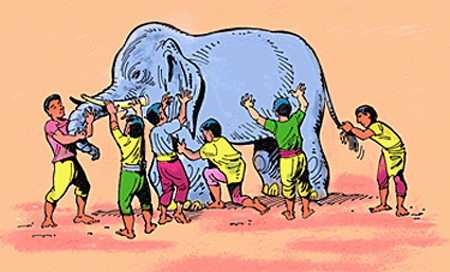
As you can see, it is rather lame reworking of the Six Blind Men and The Elephant, but its essence is of such significance that I would care to apply it now, with the help of two Iraqi bloggers to establish what happens when humans refuse to look at things except from their own perspective, which is of course half-right, but ultimately wrong and misleading.

On the left side of the pyramid we have Iraqi Mojo, an educated Iraqi-American, Iraqi Mojo does not hide his identification from the beginning, a Shia who fled after his family has been persecuted during the times Saddam was pursuing Dawa party members. Iraqi Mojo says he has no homicidal hatred of Sunnis, as he says when he met Sunni Arabs, the way you would speak when you explore a new species in the Amazons: "I have met Sunni Arabs and they are really nice." That's quite lovely of him, but even though Mojo occasionally talks about Muqtada al-Sadr's antics or his lack of love for Shia theocracy, they don't seem to be much of his concern, he rarely posts about them, if at all. For the curious American bystander who is curious to learn about how to get the hell out of Iraq, Iraq's problem, viewed through his blog is one long wail against the solitary horrors and evils of al-Qaeda, Wahhabiya, Saudi Arabia, the Arab Jarab (a term he often uses) and just about everything else you would expect a self-respecting Shia to hate, either intentionally or not, and all of which are, incidentally, the evil creations of the same very nice Sunni Arabs brothers.

And on the other side of the pyramid lies Twenty Four Steps To Liberty, I'm not exactly sure about his background, I've met him during the Iraqi Bloggers lone meet-up back in 2006 and he seemed like a pleasant fellow, what happened since then? beats me! While Mojo is at least a bit subtle, his point indirectly unfolded through links, 24's blog is fast approaching Layla Anwar-standards of rabid frothing as we speak. According to 24, all we need to do is unseat the evil, sectarian, IRANIAN IRANIAN IRANIAN puppet government of Maliki, supported by the stupid, evil Ayatollah Sistani (who is Shia, as you and I know), and everything will be automatically Plug and Play, maidens will dance, children will smile, music will play, and the hero would kiss the girl as the sun happily sets between the two ancient rivers, cue to credits, A FILM WRITTEN AND DIRECTED BY: Twenty Four Steps To Liberty, (subtitle: Fuck Iran)

and here, friends and neighbors, is the problem of the Iraqi people in a nutshell, both sides are holier-than-thou know-it-all who blame everything on the other evil, world-domination-type side, rightfully justifying their own bloody massacres in the extent. Neither are willing to even stop and consider if the other side has anything to say, neither are willing to seek a form of compromise for pursuing a somewhat co-dependent relationship. This is especially complicated of course with the unfortunate case of different religions (forget sects, Sunni Islam and Shia Islam are entirely different religions), and religion is the most powerful brain-washing force of all time, as both sides are especially inclined to dismiss the other's viewpoints as fabrications, either willingly or not.

So, oft in theologic wars
The disputants, I ween,

Rail on in utter ignorance

Of what each other mean;

And prate about an Elephant

Not one of them has seen!

We can apply this wonderful parable to everything, let us take Saddam Hussein for instance, today, apologists would say, as they are saying all over the place, that Khomeini's first objective after securing his foothold was to help establish a similar regime in Iraq itself, through the willing hands of Shiite clergy like Sadr and al-Hakim, a fact Khomeini himself had reiterated over and over again. In this context, the clash was not sectarian in essence, but that was an additional motif to the eternal battle between Secularism and Theocracy, hereby, the Dawa party and their aides were in fact the aggressors, since a clash was inevitable, Saddam attempted to preemptively strike Iran while it was in disarray, already an attractive target with its huge oil reserves, and so, from a purely Iraqi POV, and according to the Survival laws of Darwin, Saddam Hussein is a very heroic figure who tried to elevate his country's stature and power in the region.

That of course ignores a lot of important details, Saddam was a megalomaniac whose lip extended a lot more than his bite ever would, couple that with an extraordinary amount of self-importance and ego, visions of greatness (same as present-day Iran's), an inferiority complex towards Jamal Abdulnassir, and a quick-tempered sword that has not even the tiniest remorse for human beings, and you get your picture a lot bit better. Of course, Shia-Kurds wouldn't look at him this way, for them he is a cartoonish sectarian warmonger with a devout intent on decimating everything in his way.

And so these men of Indostan
Disputed loud and long,
Each in his own opinion

Exceeding stiff and strong,

Though each was partly in the right,
And all were in the wrong!

Tuesday, January 22, 2008

Parliament Approves Interim New Iraqi Flag (constantly updated)

I have nothing to do today and snow is eating up Amman today. So I'll just this post as things progress.

The Kurds did it, the Iraqi parliament today approved a new interim design to be approved for one year with a majority of 110 out of 275, 100 MPs were absent from the session. The new flag drops out the stars only.


By the way, the "Allah" in this flag looks suspiciously similar to Allah in this flag:


Supposedly, the three stars represent the three Ba'ath Party slogans: Unity, Freedom and Socialism, in reality, the stars reflect those of Egypt and Syria at the time, Iraq yearned to be the third state to join the United Arab Republic (whose flag was an exact replica with only two stars) - Maybe Saddam changed it later to the Ba'athi slogans, but that doesn't matter now, the only thing that matters is that the Kurds had their say and strutted their stuff.

The news is all over the satellite channels, Iraq's supposedly best channel, al-Shariqya, had an item that tried hard not to puke all over, it showed its intention laughably with the closing line: "All the countries of the regions have stars or crescents in their flags, except Iran." Talk about professionalism!

Monday, January 21, 2008

More Iraqi Flags

Maybe we should turn this into another silly internet meme, like lolcats. meet:


After the fiery Iraqi blogodrome discussion, in which a casual Laith showed his fears of religious slogans, only to be almost devoured by our tamed fundamentalist resident blogger, we all came to the conclusion that the best Iraqi flag is this:


After all, Good old Greendizer is really loved by all Iraqis, even the fake ones, mu baba?


Here's another one I created, inspired by stickers put by Iraqi Kia drivers:


A very old joke, I'm sorry most of these great jokes cannot be translated:


Hehehehe. I'm sorry, Mr. Flag, it's just that we can't leave you alone for a few years.


YA RLY! This one is pretty much stale now, but I included it for the sake of completeness:

Thursday, January 17, 2008

The New Iraqi Flag


The recent development in Iraqi parliamentary hell was the second major attempt to pass up a change for the Iraqi flag an national anthem, after the major failure of the 2004 attempt. As suspected, the instigators of this move is yet again, our lovely northern brothers, the Kurds. As a minor compromise solution, an interim design will be approved until a final decision will be made on the final flag and the new national anthem a year later, details are still hazy, and numerous suggested interim flags have appeared on the net, but most prominently the one that only changes the phrase "Allah Akbar" to yellow, the traditional color of the Kurds.

When the new 2004 flag was presented, like many other people, the flag felt strangely alien and removed from me, it boldly dispensed with the traditional Pan-Arab colors (red, green, white, black) which compose most Arab flags, to add insult to injury, it employed a palette that bore a close resemblance:


Same as many other people, I did not understand why a need to change the flag was even necessary ; it never struck me as a symbol for anything but Iraq alone, and it was also a damn good flag.
But then I read the history of the Iraqi flag, it is apparently the most unstable flag of the Arab world, changing for four times, and each time, the change coincided with the installation of a new, radically different political system. It started in 1921 with the traditional Arab revolution Hashemite flag, only different from Jordan's by one star, through Qassim's communist period (some people still use this flag in forums), into the traditional horizontal-stripes red-white-black Pan-Arab flag adorned by the Ba'ath party.
With the realization that the Iraqi flag is not a sacred symbol as I expected it to be, I rationally concluded that, in order to entirely proclaim the beginning of a new chapter, then a new flag reflecting that change in Iraq must also be set in order. I must say however, that this change got as far as my brain, my heart was still beating auricle and ventricle under the banner of the old flag, and it's really hard to come up with a flag that can express Iraq as part of its Arab universe but still indicate the supposedly "bright change" that is to come.

And then I began to consider other factors:

1. the only people who are actively seeking the retirement of the old flag and who hate it with all its gut are, unsurprisingly, the secessionist-dreaming Kurds, who are still dreaming their little chauvinistic Pan-Kurdish pipe dreams while we the Arabs, the ones who messed around with those Pan things and failed a century before them can now enjoy this black comedy as they follow exactly the footsteps of our miserable fuck-ups, worse yet, they can't seem to even find the first step.

2. The majority of Iraq, even the Shias, who have suffered intolerably under Saddam's Iron Moustache, do not look upon the flag as an extension of that hateful persona. Why? Because, slowly and surely, the realization began to form in my mind, that this flag represents Iraq. After all, this is not a Baathist flag ; it is an ARAB flag, more precisely, it is a Pan-Arab flag: Egypt and Yemen, both non-Baathist countries, bear the same design.

3. The nation-state of Iraq is only 75 years old, it has no traditional flags it can revert to (like Germany and Russia did after the collapse of Nazism and the USSR respectively) except the Pan-Arab revolution flag which is based on traditional Arab-Islamic flags, our current flag also holds the same colors, except it's much more kick-ass.

4. Building on point number 3, and taking into consideration that the current flag has been used for 40 years, more than the period any other flag had been used (the runner-up Hashemite flag was used for 25 years), this flag can be considered to have seeped comfortably into the public consciousness to attain a rightful claim to a flag that everybody agrees upon as representative of Iraq alone.

5. MOST IMPORTANTLY, Any flag, regardless of how beautiful or reflective it is, born under those miserable circumstances Iraq is passing through, will be first and foremost a representation of those conditions before anything else, and thus will be reviled, detached and despised by the very people it is supposed to rally.


Hence we conclude that this flag is a valid foundation upon which only minor additions may suffice for a change, if at all.

And also we conclude that the only reasons by which a person can diligently hate this flag beyond reason, like our brothers the Kurds do, is

1. your absolute intolerance of Arabism or Iraqism.
2. Your indifference to how much problems the change of the flag would cause because you are all you care about is your own little mountainous kingdom *hint hint*
3. The only patriotic pretext for hating this flag would be your legal right to hate Pan-Arabist movements, one of which was the Ba'ath Party. BUT this is negated by #4 above.

That and that alone. Of course, the Kurds have the right to determine their destiny, but if they wish to remain part of Iraq, they must tolerate its holiest icon, okay, let us be the generous ones here, we already know that you Kakas hate Iraq, but since our envisioning for a new, better chapter of Iraq would be a better representation of its more overlooked constituents, we might tolerate a reflection of your 17% presence on the flag, but not, of course, in the center, what do you think this is? I think a better idea is to put you as footnotes, or margins, like this:


The Iraqi parliament is holding a competition to choose the new flag, but did they ever consider a referendum to see if people wanted to change the flag?! maybe I should submit my brilliance...
This website (Arabic) contains many submissions for a new Iraqi flag from all over the world, they range from crayon crazy to helplessly romantic (Doves and hearts?! What is this, Snow White?), click the links to the left of the website to see them.
One of the interesting symbols I've seen in that site is the 'Babylonian Sun', this might be a good thing to put instead of the three stars, a remnant of the days Iraq was the potential '3rd state' to join the United Arab Republic after Egypt and Syria (afterwards, their meaning was changed to the Ba'ath Party slogan: Unity, Freedom and Socialism.)


Look a bit too much like Egypt, but then again they all look alike, when I was in Syria I kept thinking why the hell are they hoisting our flag everywhere?!

All in all, the issue is quite preposterous, and is only raised up because our BROTHERS (aargh) the Kurds, want to show us how strong they've become, quite indifferent to the hellhole all of Iraq has become, so as Shalash al-Iraqi said to Mes'ood Barazani the day he lowered the Iraqi flag from Kurdish soils: If you don't see us from your high mountains, then we don't see you as well.

Friday, January 11, 2008

Review: Pride of Baghdad


In 2003, four lions escaped Uday's private zoo, they were shortly killed afterwards by US troops. The incident took its short lifetime in the news, the sort of trivia to dumb down the war just a little bit before disappearing to join similar anti-depressant news that only lightens things down a minute away from the usual refrain of pounding morbidity.
Thankfully for the rest of the world, that story caught the attention of writer Brian K. Vaughan.
Of course, if it wasn't for the fact that this was set during the Iraq war, I wouldn't have even bothered ; I'm not a comics fan, and like Shooting War,the major elements that compose Pride of Baghdad are all tried and tested, after all, an epic story about anthropomorphic lions was all the rage back then when Simba tried to reclaim his father's kingdom back in 1991. Why, then, is this story one of the best things I have ever read?

Upon tackling an issue as grand as war, novels with an all-encompassing altitude often end up as the victim of their own ambition. Vaughan clearly understands this, and he limits our view of the war-torn Baghdad to the puzzled lions of the Baghdad zoo, don't be fooled by the choice of heroes, Simba and Mufasa are as close to this pride as 60s campy Batman was to The Dark Knight Returns, from the get-go, and amidst the frenzy caused by the US bombing, a giraffe beckons the old gods and then gets her neck cut open by a falling missile which quickly sets the tone of an uncompromising end-of-the-worlds apocalyptic mess, there are so many things to recommend about this book, but its strongest asset is that it completely dispenses of uninformed political statements, it is at its most distilled a straightforward story of a family's survival, which favors a universal approach other than burdensome commentary, that is not to say those lions aren't subliminally political, but they aren't as embarrassingly obvious as the film version of 300 like hastily attached deformities, there are causal throwaway one-liners about the price of freedom, well embedded in the story which is in itself so good that you hardly see them as little more than complementary dialog most of the time. The story is particularly well helped by a sense of doomsday urgency and massive exploration and fascination, particularly the discovery of ordinary constructions of human beings, who are insignificant if not incomprehensible here, most of all, the writers know that first and foremost, a story must move the readers before everything else, the visuals are incredible as well, bringing a magnificent majesty through Miko Henrichon's rendering of war-torn Baghdad elevate the otherwise standard-fare constituents of the story into more than the sum of its parts. Like any good song, the book succeeds in working on multiple layers simultaneously, that by the time this roller-coaster ride of a book comes to a close to its brutally inevitable climax, the creators build up strong emotional rapport between the reader and the lions just to the right point where they take it all down, I was completely mesmerized on various different levels, the abrupt finality, rendered in an unforgettable frame, registered to my memory the thoughts of many Iraqis, sprung from their cages, clueless but fighting with all their struggle to save themselves and their loved ones, Iraqis who were killed with such inadvertent simplicity, in complete denial of their humanity and all that they've been through, it was such a powerful moment, both in the straightforward lion and the allegorical cost of war sense, that rendered me visibly shaken for a long moment.
It is clear that such a powerful work of art cannot be easily followed, and Mr. Vaughn has every right to bask in his triumph as much as he can, as Pride of Baghdad makes almost perfect use of its medium's aesthetics to create the unexpected war story that lays down the cost of war at its most engrossing and harrowing, it succeeds on all fronts and fulfills every ambition. A must read.

Thursday, January 03, 2008

Review: Shooting War


This webcomic-turned-graphic novel about the Iraq War follows the misadventures of vlogger Jimmy Burns, after a freak coverage of an explosion in New York places him at the forefront of shock journalism, he is hired by an exploitative news network and sent to Iraq, where he finds himself submerged in a cesspool of "Jesus and Jihad maniacs" left and right.

I have heard of this one casually on TV, and I have so far read the unedited free eleven chapters online on the website, as an Iraqi, I came naturally expecting some gloss oversights in the depiction of my beloved Mesopotamia, after all, the comic would most likely not try to burden its intended audience with unnecessary details about the culture and nature of the conflict, and this being a comic book, exaggeration and tampering in favor of action and excitement is the norm, right?

Wrong. First of all, this is not a comic book ; it's a graphic novel. And graphic novels as such, exemplified by the Pulitzer-winning standards set forth by Art Spiegelman's Maus, stem from the their ability to present somber realism in an abstract perspective, indeed, the Iraq war is not devoid of elements worthy of a frenzy "clusterfuck" narration as the comic calls it, but rather unfortunately, this novel fails on the single most important area where it could count.

Like many tongue-in-cheek works about war (think Joe Haldeman's The Forever War), the only dialog this novel knows is one steeped in deadpan humor, the depiction of "Greenest Place of all of Muhammed's Green Earth" is dystopia as best as it can get, there are a lot of interesting depictions of developments in blogging, media, American presidency (John McCain), and Tom Cruise's personal life, this is all well and dandy so far.

Unlike the guys who wrote this comic, I've reserved an hour and researched them, the Internet says that Anthony Lappe, the main showrunner, claims he drew upon his experiences while he worked in the Iraq war zone, one thing's for sure, this Lappe guy doesn't get out much ; for a novel that's supposed to cut the bullshit to a minimum, this effort is laughable. Okay, so I might be willing to forgive the stereotypical condescending portrayal of every Iraqi with a traditional attire like some Gulf country, hell, even the commonplace Hollywod insult will go by me just fine ("Ice is civillization", declared proudly by the uber-cool Burns to a poor Iraqi receptionist, only he's wearing a Pakistani outfit :) ), add to that the only good Iraqi character is the educated Westernized woman, another ancient "compromise" character right out of the "hey, I didn't say you're all bad"; but this "scary smart" novel started to make me laugh for all the unintended reasons at the horribly ignorant and contrived plot ; apparently, as soon as he sets foot in Iraq, our hero is kidnapped by a terrorist group near Anbar, called the Swords of Muhammed, led by Che Guevara with a Keffiyeh, your run-of-the-mill megalomaniac ultra-villian, this is all okay, except for one huge error ; this group is Shiite! Har Har, okay, let's forgive this minor slip for the sake of the general drive, but by the time you are bombared by lines such as : "The Badr militia is going to target the Green Zone with Qassam rockets." You start to question the intelligence of all those comments that praise this "real as it gets" drama, okay, I'll be even more considerate of your South Carolina Teen ideas about the world and would accept all this if there was any good story in sight, but there's nothing here you haven't seen before, the only appeal of this story lies at its ability to depict reality, when you see that it's nothing but a random exploitation of current events written by somebody who clearly knows nothing about the topic, you only sigh and wonder if Americans will ever learn from their mistakes, this comic clearly commits the same error Dubya and his hungry compatriots it so loathes did, it think it knows everything. If that's all not bad enough, it is clearly Islamophobic, what is there to say about a comic which believes that both Shia and Sunni Muslims are a single monolithic entity that so feverishly wants to spread its religion over the evil West so that every woman and child are part of its holy jihad. Indeed, those stereotypes were as much contributed to by our beloved terrorists than it did by the west, but you'd hope for something much more real from this "all-out" novel than frustrated Sunni Moroccans recruited from France to carry out an operation for the Shiite Badr brigade with Iranian passports?! okay, so they are really part of the Swords of Muhammed group, unfortunately, that one is Shia too, and it operates in Anbar and condemns the massacres of Haditha, Najaf, and Falluja. So much for your clever twist, and novel.

Monday, December 31, 2007

Konfused Kid Abandons Heavy Metal

In a shocking turn to his fans, Iraqi Konfused Kid, formerly known as Iraqi Konfused Kollege Kid a.k.a The Kid Himself decided to officially declare the end of almost six years of bone-crunching, fist-pumping, devilless-worshipping devotion to heavy metal.


It has been six years since that fateful day when The Kid, at that time a lonely, reserved misfit whose existence was largely supported by video games and Eminem, heard that ominous call, there was no magnificence in that moment, it was actually a boring evening and The Kid was flat on his ass checking out the new cassette he recorded at the nearby Radio1 shop, but at that moment when "No Leaf Clover" came bursting out the seams of his cheap Chinese player, that he felt like an ancient prophet in a cave.

After that, The Kid's mindset was completely captivated by the magnificence, power and intelligence this form of music can evoke in one's being ; little did he know it, but at that period of his life, he actually worshiped Heavy Metal, and NOT in a metaphorical sense of the word, all his existence was more or less devoted to that obsession, he saw in those drug-addicted, half-naked school dropouts the pinnacle of human evolution and development ; often did he sit late at night, pondering like a historian over manuscripts at their lyrics, carefully trying to "understand" the concise interpretation of this lyric and that, the epic, dark compositions uplifted his spirit and gave him meaning. In fact, unconsciously he believed that the juxtaposition of music and words in such a fashion unlocked a dangerous magic of its own that can only be felt and understood by those devoted followers, from this logic, he considered those rare specimen who agreed with his ways, whom he met during high school as especially enlightened human beings, who had managed to see beyond the usual range of short-sighted men, those men would simply label these highly powerful creations as 'a garbled mess that has nothing to do with music', The Kid knew of those people deviated ways for he had lived upon them for 17 long years, reveling in disgust at their stupidity and 'uneducated animality', he had seen their corrupt, idiotic music about love and butterflies, formless and odorless, and yet another facet of their inferiority, he loathed their attraction to the simple and benign and treasured the complex essence of the truth he had harnessed and uncovered in those magnificent manifestations of the divine. Often did he and his compatriots talk about forming circles to practice the faith, but he was often disappointed in his colleagues, for sometimes he thought that except for their admiration for this music, they were still the savage inferior beasts he saw everywhere, and that they did not hold the key of the knowledge of this great realm like he did. Undeterred, he silently upheld his new faith and tried secretly to flourish within the confines of his society. He had no money to buy a holy instrument, so he secretly practiced his faith passively behind locked doors, he loathed headbanging, which he considered to be an extremist invention that had harmed the faith more than it benefited it and led many common people to shy away from it in disgust, instead, he preferred to air-guitar his emotions while making performer poses and creepy faces, often fantasizing himself to be in the center of whatever social unit he was part of at the time, Singing 'The Wait' in his schoolyard, or fingerpicking 'The Call of Ktulu' in the living room, in those fits of fantasy, students of the school would gaze in awe, and his family would water their eyes, everyone would bow to his greatness and testify to his superiority. He would then sleep comfortably while analyzing the subliminal intentions of the complex faux-pop songs of Soundgarden, before waking up to another tasteless school day where he served as a nondescript entity in a world he felt he did not belong to.

From his youth, The Holy Kid had perceived hints of what was to come, at six years old, when The Kid was still held by his family to be some sort of tortured genius, when he could have told you the capital of any country and the number of days it took Hitler to invade any European country one by one, The Kid has often wondered, for no reason at all, if his playmates were some sort of robots, who were programmed to think and feel in the same predictable emotions, the faith of Heavy Metal came to confirm those theories about the inherent stupidity of those people, and increase his longing for a holy hijra to the promised lands he often saw in television screens.

Years passed and The Kid graduated, having devolved from a child prodigy into a plain and unremarkable dude, more plagued by his supposedly miscast nature than anything else, he joined college, determined to convert as many as he possibly could, into his new philosophy, he had crystallized his teachings in a simple leaflet, and he termed it 'F.T.W.", his determination paid through somewhat, for after years living as a misfit, he seems to have picked up, quite inadvertently, something of human social conduct, and for perhaps the first time in his life since his teenage depression, The Kid found himself to be truthfully enjoying his presence among the ignorant population of his perimeters. He had gained a few converts on the path of truth, and believing his happiness to be stemming from that blessed foundation, he continued in that path unabashed. Yet still, in that warped form of thinking, The Kid was still believing on some level that there are better, more 'educated' human beings out there and he often longed to meet them.

However, by 2006, the actual spell-binding aura which had protected him all these years had slowly faded away, the holy incantations did not move him like they once did, but he relentlessly listened to them in an attempt to bolster his faith, believing this to be a minor lapse, shaking away whatever childish demons that tried to manipulate him, unfortunately, it felt today like a regular routine with no emotions, he now had the means to procure a holy instrument, and be bought three of the blessed tools, thinking that the time had finally come to spread the doctrines into the unsuspecting hordes, to rescue them from the vile clutches of the satanic devils of Arabic pop music.

Laugh not, for The Kid genuinely believed this crap as intensely as it is shed here, he just did not know how religiously he believed in it. It was his driving passion, during boring lectures, he was found of creating setlists for imaginary live shows, he was forever obsessed with the correct order of songs in order to persuade the heathens into the true word of the divine.
But as 2006 drove on, more and more did The Kid find himself more suffocated than liberated by his faith, the search for new items always proved disappointing, both the new and old music he tried to explore he found to be rather lame attempts to sound glorious and evil, most of the bands only had a handful of good songs, barely fitting an album, and by now it had become something of a joke, a ritualistic practice that regulated one's conformity to nonconformity without any true quality of its own, like a failed Pan-Arab revolution ; you like this? then YOU MUST like this, or else you suck! Unfortunately, The Kid cannot pin down an exact moment when he said: "That's it, this is just too ridiculous! But it can be narrowed down to the following moments: The moment when his fellow friend snatched The Kid's holy instrument and played an Arabic medley of the sort The Kid looks upon with aristocratic disfavor, but to his own amazement, it appeared to him for the first time to have a magical shape of melody and it took him to those faraway mental escapes....maybe it was the fact that The Kid couldn't play shit at that time, anyway, this small bit took The Kid into a re-examining of traditional Iraqi songs, apparently an easy way to get people's attention instead of numbing their heads with chugga-chugga, this little oriental piece proved to be quite a decisive Trojan horse later.

But most importantly of all, it was The Kid's first foray at playing with dedicated musicians, there were two of them, the bassist was a weird, but overall okay person. but the lead guitarist, Teez (his real name), was another story. Teez was supposedly Iraq's self-proclaimed 2nd greatest guitarist of all-time (the first being Saad Zai), Teez was like The Kid's musical aspiration taken to extremes, a very idiosyncratic, egotistical person who apparently sucked at everything but playing guitar, and because of this very perceived insecurity, Teez used to insult and mock everyone whenever he could in order to be assured of his prowess. Teez was especially unbearable, and The Kid, now less unsocial and with friends and some girl to talk to late at night, found him to be rather a chore and a model of a human being he was afraid he would become. He loathed Teez, and with this realization, he loathed even more the archetype of the Iraqi 'mattalla' community and its trappings. Another practitioner of the faith, a girl who was even more devoted than himself and into black metal, which we could call 'Sufi Metal' shit, actually got married to another heavy metaller just because he was into the same shit more or less, having been a witness of the hollowness of those petty lives ; it was then that The Kid realized that those 'uber-human' people he dreamed about were nothing but imaginary, like the myth of the Mahdi, and that everybody is more or less quite ordinary ; if anything, those misfits he was one of were as remote as anyone from attaining a higher experience of life, it was more like an amateur venting of frustration that eased itself out through music instead of the way Osama bin Laden or the Virginia Tech killer would do it. If anything, those idiotic animals we held in contempt were having a richer, more realistic life than this denial.

With the death of his friends, and his growing interest in politics and religion, The Kid began to read less English and more Arabic, amazingly, the Arabic culture DID turn out to be capable of producing the intelligence, wit and imagination that he so respected and thought unique of Western culture, this reflected on everything of the Kid's behavior, he stopped wearing stupid rock/tanta clothes, began reading Arabic poetry and history, and music-wise, he is now dancing to the same music he found years before to be tasteless and inane, as a matter of fact, whenever an English-speaking song comes about on his play list, he immediately skips it, mentally commenting on its inability to possess the soulful, melismatic qualities of Eastern music. Sighing at the thought of all those leather-pant-dreaming western-wannabes who think they know something.

The moral of this story is that everything taken to extremes is bad, yes you might like something passionately and that's cool, but don't read too far into it, as it puts you in a warped plane of reality that is more often not really the be-all end-all you think it is, Here I only liked loud dark music, which doesn't hurt anyone necessarily, but still, thank God it wasn't something like religion or race.

To give you an example of how my life depended on Rock, here is a piece I wrote in my wee-years in 2002, about the song which I still consider the song that affected me most in all my lifetime, No Leaf Clover, compare it to this article I recently discovered which looks with the same academic analysis and fascination at an Arabic song, apparently, there are maniacs found for almost everything! The idea I'm trying to say here is that Your God can be found in everything, and one should really respect other people's beliefs no matter how inferior they sound to you, for you could end up liking them one day, and if you asked me right now, I'd say that this woman is the greatest singer in the world.


*****

NO LEAF CLOVER, Metallica.
Written by James Hetfield/Lars Ulrich
Reviewed by The Kid in 2001-2002
NOTE: You might not understand a lot without listening to the song (YouTube link to the left) first.

*REVIEW BEGINS*

This is probably the foremost fusion of words and music I have ever heard in my whole short life. Never has a song offered such power, emotion, and atmosphere as this one. While lyrically the composition is vague and daunting, with such everyday indistinguishable words, the mirroring of their ideas into the music is what makes Clover totally mind-blowing, the song was performed only once in 1999 in a live show with a SYMPHONY, Metallica wanted to demonstrate that their music owe a lot to orchestrated detail and this one is the prime example of their complex emotional treatment. The song is intended as mourning for the death of a wild, careless human. After a good intro from the symphony that introduces the main riff, the song really starts by James playing a creepy arpeggio figure played on a clean electric guitar, while the symphony coats him with a vivid, Swan Lake-like impression, which puts across a very serene, angelic, and mysterious atmosphere. In what is one of scariest sudden-shock experiences the whole environment is turned upside down by a thundering electric guitar with only a split second of transition between it and the previous calamity, ensuring a devastating back-to-life effect that is both cynical and crushing. In the same moment, rumbling Tambourines underscores the effect, to create a march that eventually reaches conclusion with a loud snare/cymbal crack from Lars Ulrich's drums, the last note is made even more haunting by a short epic horn play, it gives the impression of a vicious resurrection of a sudden mystic power, like the visceral awakening of a slumbering, long-forgotten evil. All this happens in only three seconds, which shows the depth and the understanding of Michael Kamen (the symphony conductor), immediately after this short 'transition' the music ferociously recite the verse riff (NOT the main riff), a heavy riff with a sort of a military seriousness to it, after a full bar James Hetfield comes on the vocal, in a melody that is both wailing and sadly mourning, the sort of reaction you'd expect from a mother who's throwing fits over the dead son, he sings in high-pitched, multi-layered shots : 'And it feels right this time'. The first verse mainly resembles the youth's life, with the loud, dense collaboration of rock and classical furiously ensuing the heating, blazing atmosphere of a wild life revisited in retrospective. The mourner then proceeds to shout some of life's best virtues, in cynical, agonized bites laid together in an abrasive, animal satisfaction and simplicity 'and it feels right this time/ on this crash course feel the big time! /pay no mind to the distant thunder/beauty fills his head with wonder, boy' stating the viewpoint of that said careless individual. When he reaches the verse's end 'Good day to be alive he says' he increases his intensity on the last syllable of 'says' while the symphony proceeds to lift up, then the vocal echoes to create a sort of a dissolving effect as the guitars slow down, the spirit of life is suddenly faltered, and vanishes in a puff of smoke, out of which silently the haunting guitar line of the introduction is reintroduced while James Hetfield leaks the sadness he's conjured in a low-pitch mumble, you could actually see how wild life decomposed into the nothingness implied by this chorus, which is even made more touching by the line : 'Then it comes to be that the soothing light at the end of your tunnel / was just a freight train coming your way' It means that the distant, unclear thing up ahead of your life which you have not paid much attention to is basically the much-dreaded end, coming towards you in immeasurable speed, at the same time James pulls out an evocative vocal delay on 'way' the symphony menacingly rises up again, and a soft, assured kick drum then proclaims the impact moment, it's as if this slow moving, giant and inevitable slab of fate hits yet another piece of clay on its never-ending travel, easily plucking it away from the frail roots it had fermented earth with. James repeats the chorus line with percussion and a more refined angelic surrounding, with Jason Newsted's bass remorsefully throbbing a few reflective notes before the whole set is pulled back to the pit again, this time the lyrics deal with outcome of the man's mindless life and where it had led him: 'Does it feel right like this?/ All the pieces fall to his wish!' the 'his' in here is either a tribute to God, meaning that eventually everything happens according to God's will, or the other way around, stating that Devil finally got you and all the things he fed you with finally worked, probably the latter is more accurate as in the next line he blames the deceased for his easy trickery into life's 'quick reward', which, however, could imply God's reproach or devil's denial. After another repetition of the chorus, James struts a bit on the warning line 'It's coming your way', all this, however diminishes when compared with the song's bloody climax: After having Kirk Hammett (lead guitarist) play the silent intro guitar distorted –which creates a sort of a bottled suffering, with James's guitar behind descending into minor keys- the song then reaches the final point, undeniably the best part of the whole song, while at the surface the tension is mercilessly released with an out-of-control Hetfield frantically screaming the chorus line in paint-peeling high-pitch saturated with high voltage energy that would put any nearby Celine to shame while his guitar textures paint a chaotic mood underneath his bellows, the actual undertones is very much in precise control, the symphony tackles the dramatic apocalypse with a few violin notes, which paves the way for Kirk to repeat his distorted intro trick, it achieves the sort of fulfillment the song needs. After this heartfelt outpouring of the chorus, the set repeats the principal riff, and ends on a rising violin note underscored by grumbling tambourines. A sad lament to a deceased individual, and a big warning sign to everyone who is willing to listen. I still remember how it threw me upside down; I never knew anything about music other than it's just a way of spending just a fun time. This one literally blew me away (I kid you not, the actual analysis of this classic took me about six months, before that, I just listened, but I never expected the impression to be so awesome, I was too lowbrow to express my feelings anyway) and eventually it changed my whole outlook on music as not just a tool for having fun, all the silly, kitschy pop music seemed absurd and meaningless, it frightened me that a band with such depth, detail and intelligence actually exists, and if only a tenth of music was as good! It also harbored an as-yet-unexplored interest in classical music, often touted as the highest form of music. It taught me to carefully examine artistic works: books, photos, pictures, songs. Everything had whole new dimensions upon closer inspection. Consequently I found out that this line of thought has even influenced my usual real life relationships and social judgment of persons. Given the song's genuine impressions, it's hard to believe that it is also one of Metallica's most accessible works, while most Metallica classics would take a dozen listens to comfortably sit within the mind, this one could be absorbed in just a few listens, with little details slowly cropping up with each listen, ensuring the song's long lifetime. No Leaf Clover's most noticeable trait is contrast. The contrasting themes between harsh life and silencing death are so strongly realized on all aspects of the song: the music is hard rock on the verses, disproved by the symphonic laid together focal chorus; the vocal is an agonized, mindless simulation of ecstasy done in screeching high-pitch at verses, while at the chorus it's so solemn, peaceful and low-pitch it's hard to believe they came from the same vocalist, this theme is even engrossed in the lyrical context: from the barks of an underdog to the metaphors of a philosopher, even the title -'No Leaf Clover' is the diagonal opposite of a four leaf clover, a luck sign- is a contrast in itself.Several other theories have been discussed as of the actual meaning behind the song (the band rarely gives out interpretations of their songs) including a war theme (Metallica has often written anti-war songs, particularly in the 80s) and just plain, indefinite bad luck, but the song's epic, larger-than-life atmosphere and high musical vocabulary allows no compromises; it deals with the highest form of the old good-and-bad conflict, the most important of humanity's struggles.
Saturday, December 29, 2007

Iraqi metalheads rocks Istanbul - 22 Dec 07

Look at this awesome report done by al-Jazeera English on the fearsome foursome, indeed, as evidenced by the VBS.TV documentary before, Marwan still is the most impressive person of the lot and he's still the only one who exudes a cool-guy aura with his deep voice, this one made me yearn back to hungry days rocking in my bedroom. Good luck guys, i hope you do write something good finally...

Wednesday, December 26, 2007

Iraq's Only Heavy Metal Band In Turkey

Apparently, the heavy metal documentary VBS.TV did on Accrassicda a few months back has been screened at the Toronto Film Festival, but instead of helping them, the four grammatically-challenged metallers of Iraq are now regretting the media coverage, having denied Visas to attend the premiere in the US, and facing imminent deportation, they have sold their instrument and used the money to run to Turkey, where they are trying to settle as UNHCR refugees.

For the lost souls of the members of Satan-brainwashed Accrrrraaaassscccida, I wish them a Happy Christmas, a Merry Eid, A Blessed Hannukah, and a Fucking Awesome Eid al-Ghadir, may Allah/Jesus/Yehweh/Abu al-Hasneen be pleased with all of us. Hold on to your virgins, too many holy festivals! Let us hope that they rejoice one day in peace, and not commit holy martyrdom in the name of Ozzy Osbourne on the altar of the Church of Punk like our great Ayatosatan Kurt Cobain (AS) did one stupid depressed day.

Wednesday, November 21, 2007

The concept of 'Gheera'

The iraqi-arabic word 'gheera' is hard to translate, an offspring of the distinct Middle Eastern mentality, the closest Western word to it is 'honor', but it lacks many of the connotations that makes it different from 'sharaf' which is the literal 'honor' in Arabic.

The Iraqi 'Gheera' comes directly from the classical Arabic 'ghayoor', I haven't heard it being used in other Arabic dialects, it stems from the same human feelings of 'pride' and 'honor' but it is also much more than that, perhaps the 'gheera' has its roots in the Beduoin-descendant importance of protecting the family, especially the women. a 'ghayoor' or an 'abu il gheera' is the proud, honorable William Wallace type of person.

The dilemma of translating 'gheera' came to me when I was trying to translate the following poem, I normally consider patriotic Iraqi songs hypocritical, but apparently, everything can be great if it's done well. and this performance have never failed to stir me, even the over-the-top, bullshitty parts, Hussam al-Rassam, currently Iraq's favorite singer, did an especially good job here, somehow I feel every word and actually the first two times it literally brought tears to my eyes on the 'children sleep on their empty stomaches' line, as you can see in the video, I was not the only one feeling this way, not to mention the way he lays down his issues with our Arab countries in a tone that conveys despair, pride, majesty, sadness all at the same time. It's almost flawless, except for the smiling bimbo at 3:30, but oh well.
This performance is actually a medley of three different 'mawaweel', in short a mawal is a small vocal performance of a poem Iraqi (and maybe Arab) singers perform before jumping headlong into a song, the mawal is usually painful and exquisitely worded, but the subject matter of the mawal and the song can be totally unrelated, for example, you can sing a mawal about the pain and suffering you feel when torn away from your country and then jump headlong into a song about stolen chickens.

Other things of note is that translation often fails to preserve the direct essence and brilliance of the mawal, especially if there is wordplay, for example the first verse which ends with 'dates', 'command' and 'pass us by' is in Iraqi-Arabic 'tamurna', 'timurna' and 'tumurna'. a wordplay often used in Iraqi mawaweel. I have tried however to convey its meaning to the best of my humble capability as someone who earns his bread by translation.

Enjoy it, it's really important.

Fair and well for those who our dates they eat
and we obey your wishes when us you command
for entirely the Basra leans when us you pass by
and Shatt al-Arab greets thee heartily...

May the Lord ails you, my country, O the cradle of civillizations...
I embrace you even if thou embrace the knives themselves....
For I wish to speak, and who is he who believes my fables...
and you, O beloved, bear the anecdotes of Sultans..
The Bread-maker, why do you give your neighbors
while your children sleep on empty stomaches?
And your walls are used but for the slogans, many are the
slogans, few are the walls...

and here you cry alone, and no one shares you tears...
For you need not a tear shed without honor (gheera)
When the horses broke into stride, you calmed their fears
and preserved them, their thrones, kings, and tribes.
Who has not quenched from Kirkuk's oil?
but who invites me on his table today?
I address he who drank Irbil's yoghurt
and he who ate the bread of Sowayra
and he who consumed Thi-Qar's masguf
and he who uttered but the single utterance
and I bemoan for Saladdin isn't present
nor is the Qaqa, nor is Ibn al-Mugheira!
O Sa'ad, do you see Rustam, at the doorstep?
On the Euphrates, his rank and file march
I address those who slept by Abu Nuwas
Lo! How the Tigris remains captive today!
O Ali! O Father of al-Hasan! Dulfiqar is sheathen, and of your
dome the cowardly chips a stone?
I remember when they clinged to my clothes
and yesterday when the peninsula preserved its pride
Yesterday, when my helmet rebound a thousand bullets
the Arab Gulf is my sea, and I didn't flee
I hold thee accountable for all that happened to me
and everyone's sin lies in the corner of his eyes
for I am Iraq, and my name shatters the heavens.


*The poet who wrote this, Samir Sabah, was imprisoned by Jordanian authorities shortly after its release, he was only released after human right organizations intervened, ironically, this concert was in Jordan.

Sunday, November 04, 2007

Who Am I?

The last comment at my last post set a wheel in motion in my brain, it's not that i have time to post right now actually ; i'm working two jobs and i'm really beat...but anyway, I thought I'd drop in a quick explanation regarding a few accusations made by a few loving or otherwise readers.

First, Annie, I don't really support the occupation, but that doesn't require my support for its withdrawal necessarily. The only thing that I really understand right now is that there is no really clear, 1-2-3 way out in this fucked up political condition anymore, in fact, there are only guys who are looking for their own interests. That could mean turning a blind eye to horrible atrocities and creating a pan-Arab hero out of a bloody tyrant, or simply focusing on that tyrant's atrocities all day long perhaps as a justification to cover today's crimes. People like t to hear what they want to hear, seeing people become simplistic entities with cartoonish views of right and wrong has taken out a huge chunk of my faith in human nature. The thing is, if the owner of this blog knows one thing, then it's that nothing is really for sure anymore, it's a huge unjust, unfair mess, be it history, social conduct, politics, secularism or religion. Also, the person known as Anarki13 once said that i'm a know-it-all twat, in fact, what you are witnessing is really just soul-searching, that hopes at getting somewhere in the end. All i did in my recent posts is just copying transcripts of what well-known authors have said, i didn't bring anything out of my own pocket. However, I must say that I've always thought of you as somebody who never listened to anybody's opinions and actually never even took the views of anything seriously but his for that matter, including my own views. So judge not, okay?

Talk about being konfused... :)

Sunday, September 30, 2007

Been There, Done That.

This person was in my college, he was my age in the IT department, me and my friends weren't very fond of this guy ; he didn't anything to us personally but he belonged to the slick and stiff category and he had enormous height and an array of suits, which certainly helped him to the purpose, he would often adopt a supposedly formal face that we liked to term 'Makil Qanadir (Shoe-eater)', in fact, a normal mini-game in our mornings was to approximate his official frown size to the virtual size and/or accessories of a shoe that he supposedly ate before coming to college. Those varied from Shoelace Noddle Soup, to the downright butch size 46 basateel.

This person was found killed alongside two of his friends in a car on the Qanat bridge, which is near Sadr City, they were back from college after receiving their exam scores. one of them was sunni and the other two were shia, the person himself worked in the interior ministry so he was probably shia. nobody knew why they were killed, and i don't think anybody puzzled much ; it's simply too common. one of the boys however was rumored to be connected to the Mahdi, which makes it even more puzzling since they were killed near the Mahdi stronghold. his best friend, who recently became a close friend of mine due for geographic reasons, called me and told me the news, sobbing. I didn't feel anything.

As a matter of fact, I did feel something for a brief second, it was - this guy will no more try to find jobs, get married, have children, be happy, be sad, travel, swim, play pool, have diarrhea. He turned in for the day.

He's so lucky.

I'm sorry Haitham, for all the qanadir we made you eat in those past years. i hope you forgive us and may you live happily ever after.

oh and by the way, blackwater, fuck you. do you think we will tolerate this anymore?


happy ramadhan.

Wednesday, August 29, 2007

The Passion of Hussein

"I have many scores with the enemy
Not only one, is that which I desire

Your back, your little finger, your liver

your grey hairs which in blood had been soaked

Your chest, your thirsty heart

Your body, My master, that which was crucified

Before you there was not a tragedy

a slaughter from the back to the back

and a head sheathed
up on the spear
From a land to another

your head, O the willful, goes round and round"

- Bassim al-Karbali'e, lamenting Imam Hussein' death in Bil Taff Lu Chinit Mawjood

I have been avoiding this post for almost a year now, for fear of meddling into a big sectarian mess that shuold be treaded carefully to say the least. However, my recent re-viewing of South Park's infamous The Passion of The Jew episode convinced me of its importance.

When I first watched The Passion of The Christ back when it was just released, like many others, I was in complete awe of the film. Deeply moved, and compounded by explicit hatred at the jews. At the time, like any good-loving Muslim, I didn't give any extra thought into the innate, inherent evil of anything Jewish.
I watched the film again about a month ago, and found that there is little more in the film that actually makes it something above a simple 'snuff film', the only significane it served is the fact that the man being killed, unlike millions others killed in a similar fashion, is the principle focus of a major world religion. The Passion itself is a medieval performance piece whose only purpose is to incite anti-semitism. Discussions into the film's possible and unintended (or intended) inciting of similar sentiments have been dead and done, but the myriad similarity between the centrality of the crucification and the Shiite's Flagellation processions is what forced me to criticise it here.

For a year, I have been pondering over and over about what Shi'ism is about. In Sunni Islam, the history of the Arab/Islamic Nation is basically: everybody lived happily ever after until very recently, the bulk of wars between people deemed companions to the prophet are often ignored or passed in silence. This amazing discovery forced me to read and re-examine my beliefs, and since then it has been an endless fascination for me to read about the history and origins of the endless Sunni-Shiite conflict.

The first thing that struck me odd in Shiism is that, while it tries hard to claim that its ideology is derived from reason and logic, it's present spiritual force is exactly the same force that grips you when you see the Messiah being whipped by Roman Soldiers until his ribs poke out, unreasoning raw sympathy for another human being compounded a million times by the perceived saintly stature of the man in your consciousness, a force so emotionally terrible that strips you of any thinking, so strong that your heart eventually convince yourself it must be true, the problem with such gushing sensations is that the heart is often an unreliable conductor To quote the late leader of Badr/SCIRI (now SIIC) Mohammed Baqir al-Hakim: "Shiism was kept alive in two things and two things only: the focus on the plight of Hussein and his mother, Fatima al-Zahraa."
There is no better example of this logic-less method of persuasion that the story of Fatima al-Zahraa's Rib, supposedly, before the death of the prophet, he appointed his cousin, Ali, as his successor, but the first caliph was Abu Bakr al-Siddiq, when Ali refused to extend allegiance, Omar ibn al-Khataab, one of the most important companions in Sunni Islam, went to his house and started shouting and threatening to burn it even though Fatima, Ali's wife and Prophet Mohammed's only daughter, is inside, eventually, Omar (sometimes not him, but a minor slaved called Qunfudh) crushed Fatima using the door of the house, that her rib was broken, and she was forced into a miscarriage of the third child Muhsin, before dying six months later, in a notorious day Shiites uphold as 'Zahraa's Martyrdom' Amazingly, Imam Ali, easily the most self-righterous, strongest and most courageous figure in Islam, did absolutely nothing for the death of his wife and child. and went to 'grudgingly' accept the caliphate of Abu Bakr and Omar, even advising the latter on certain matters, for fear over the unity of Islam!!!! This is the same Ali whose self-imposed puritanical approach to life and refusal to compromise on anything led him, knownigly, to his defeat by the more wily and persuasive Muawiya. In fact, first act on the first day of his caliphate some 30 years later was chasing Ubaidullah bin Omar, who killed a Persian without any charges after the second caliph was killed, such is his stubborn adherence to the principles, that it is seems ridiculous, even hugely insulting to his character, that he would contend with 'accepting the unity of Islam' when such grave sins were committed not only under the tent of Islam, but to his personal family and wife.

When I asked a very devout Shiite friend of mine from Najaf about Ali's actions, his simple explanation was that 'it was told to Ali that he have to act this way by the Prophet', an even more puzzling mystical solution, as the prophet could have easily dispensed of his two companions, both of which belonging to minor tribes who pose no real threat to him, when he was alive.

Unfortuantely, this illogical story is a foundation for the Shiite faith ; A neutral person, with no previous knoweldge of Ali and Omar, would have trouble not being affected by the yearly wealth of poems and latmiyas, set to heart-piercing melodies, telling in horrible detail the wounds and injuries suffering the saintly lady by the 'oppressors and criminals'. If Laughing is infections, then crying is terminal. Even though Abu Bakr and Omar had differences with Fatima, their latter actions when they assumed the caliphate were unlike those of the following tyrannical kings such as Muawiya or Yazid, or even those like Omar's successor Uthman ; they remained as poor as they were before ruling, their clothes and food remained as rough as the Prophet (and Ali's), and their actions were in the interest of the Islamic State overall. Some Shiite scholars like Mohammed Fadhulallah, Hezbollah's spiritual leader, tried to negate this story, but he was ruthlessly and harshly denounced by both the common and the other Ayatollahs such as Iraq's Ali Sistani, quoting: 'The tragedy of Zahraa is essential to our sect, and without it, our sect would become quite simply the same as the other sect.' This is correct, because to Shiism the whole idea is of a single , continous tapestry of suffering and pain since the death of the Prophet Mohammed until today, and to break a crucial pillar of that fragment would ultimately lead to the downfall of the whole sect.

That is not to say that Shiism is devoid of any positive principles, like the countless other revolutions throughout history, such as communism and pan-Arab nationalism, Shiism started with a noble true cause that throughout history was shortened to nothing more than rituals and beliefs which are recognized as more important than its true spirit, the spirit of revolution against the rulers who descended into wordly pleasures and mixed religious rule with that of a king. Open any Shiite website and you would find the larger section of the site dedicated to the Shiite Opus Dei-like hymns of flagellation, wailing over the ethereal Battle of Kerbala and all the time asking for the venegance and revenge, which easily replaced the spirit of corrective revolution as the driving force of inspiration for the creed, thankfully, that revenge is postponed until the day when Imam Mahdi (GHA) will rise up, and whose first act shall be to to resurrect Abu Bakr, Omar, Uthman, Aisha, Muawiya, Yazid, Harun, and probably Saddam, to punish them for the deaths of Ali, Fatima, Hasan, Hussein, Musa al-Kazim, Ali al-Ridha and other reverred figures. Imam Mahdi serves as the simple opium found in the cultures of many oppressed folks by which their little dreams of getting a shot at the oppression of state comes true and accomplishes what they failed to do. It is actually that story which led me to drop my belief in both the Sunni and Shiite versions of the Mahdi, the only form of Mahdi I believe in now is the Second Coming of Christ, which exists in Islam as well.

My study of Shiism also changed my view of the Umayyid and Abbasid rulers, for it is apparent as the sun that Muawiya bin Abu Sufayan and his son Yazid have played a great deal in the dissolution of the puritanical principles of religion, perhaps they were only instruments for the unavoidable current of human nature, which abandoned Ali's tight adherence to religion and sought a freer, more joyous interpretation of life, nevertheless, it clarified my vision and opened up my mind as the history of our nation, and i have to thank Shiism for that.
The following passage in the book Sultan's Preachers, by the secular Shiite Ali al-Wardi, helped me in a great way formulate the ideas I expressed above:

ALI AL-WARDI's VIEWS OF SHIISM:
We have said earlier that the Saffavids have tamed the prinicples of Shiism, reducing it into a 'slumbering revolution', a dormant volcano with only a few smokes signifiying its earlier destructive capabilites. Shiism still has in its folds innate residues of its old revolutionary spirit, extensions whose original function was exhausted and has since then functioned in a harmful, not useful manner. An objective examiner of Shiism will find mysterious social activities which deserves amazement and further observation. Rituals which would stun some of its origins, bringing others to revile in disgust at its myths and exaggerations. Nevertheless, we cannot purposefully explain those mysterious patterns but as artifacts of the past centuries where Shiism was the brinstorm of revolution in the Islamic world.
Those artifacts could be summed down in such:

1. The Imamate: Shiites today look upon their old Imams, the descendants of Ali, in a strong holy fashion, considering them infallible, and bringing them to a level above humanity, as well as seeking their tombs for intercession in every plight. The principle behind the act of glorifying Imams used to be revolutionary, an indirect criticism of the decadence of the Muslim rulers, in a fashion simliar to Plato and Farabi's Utopian society solutions.
2. The Mahdi : This belief is the principle upon which many revolutions were based, socially speaking, the Mahdi is a rebel, many rebels in the past were named Mahdi even though they themsleves did not claim to be so. Researchers were puzzled over the origin of the term in Islam, but it is clear that al-Mahdi is an arabization of Torah's Messiah, the heroic savior of divine guidance. Anyone reading Ezekiel will find a curious resemblance between the chapter and Shiism's Mahdi.Simply put, the dreams of the oppressed is the same everywhere, everytime. As the oppressed who cannot avenge his prosecution seeks a dream-like future prophecy, and builds towering castles of hope. Sociologists found that the oppressed society often tends to create myths to fight its unjust rulers, those myths are called 'Social myths'.
Thus, we can say that modern-day Shiism lost the social concepts of the Mahdi and retained the mythical shell of ideological dictum.
3. The third is Dissimuilation (taqqiya), a social pattern that accompanies revolution when it begins, old Shiites sought taqqiya to be free from the state's chase. Today, Taqqiya lost that revolutionary status and become embedded in the new religious, political and social system that the Shiites follow, a mere relic from older times.
4. The fourth is the what is today termed 'Hussein's Cememoration', which was in its earlier form a slogan for anti-state propaganda, eventually developing with the passage of time into meaningless rituals. Shiites of yore would gather in the cellars to cememorate the huge injustice on Hussein, implicity discussing state oppression on various fields, in a move simliar to today's underground rebellion movements. Today, Shiites forgot the principles for which Hussein revolted, and they would even engage against those prinicples just the same, as long as they cry and mourn him, as if this was the final intended destination. Today, Shiites visit Hussein's grave by the thousands each year, and then return like they went, doing nothing but screaming and yelling. Today, they are dormant rebels drugged by their own authority, turning the swords they fought the authority with into chains and spears.


BOTTOM LINE:
Mel Gibson:You can't say my movie sucked, or else you're saying Christianity sucked!
Stan:No, dude, if you wanna be Christian, that's cool, but, you should follow what Jesus taught instead of how he got killed. Focusing on how he got killed is what people did in the Dark Ages and it ends up with really bad results.
Jack:You know, he's right, Elise. We shouldn't focus our faith on the torture and execution of Christ.
Shlomo:Yeah. Lots of people got crucified in those times. We shouldn't rely on violence to inspire faith.
Cartman:Aw, aw, no, come on, people, we're so close to completing my final solution!

Tuesday, August 14, 2007

Shiqaqnifaq and Lot

the recent two posts by Iraqi bloggers describing their experiences at the Jordanian airport has caused a flurry of activity little seen in the Arab blogosphere,the first post was by Omar at Iraq The Model, and the second and more detailed one involves Last of Iraqis as he tries to spend a little vacation there with his wife, both posts revolve around the rejection, but most importantly humilitation, they receive as they spend the day waiting for a flight back in a room Iraqis dub 'the jail' (pictures available at LastIraqis's post, as well as a video on Zeyad's).
This was soon followed by all sorts of reactions from both sides of the British Sykos-Picot divide, in addition to others from the Arab world, ranging everywhere from apologetic to extreme far-right, I have collected the ones I could find here, there might be others:
Arguing for Iraq: Catholic Sunni Shia, Silly Bahraini
Arguing for Jordan: Black Iris( has the most interesting discussions in its comments),
Moey , Bakkouz(now removed).
Balanced: Mkilany , Qwaider,

Interestingly, further research revealed a Jordanian Facebook group called We Hate Iraqis.
Aimed at expelling the '1)smelly, 2)suddenly rich Iraqis 3)who've been less than 10 years in Jordan', I constitutionally violate the 2nd clause, but obviously i am (3) and I am sure as shit smelly, I'm sorry folks but I sweat a lot and your water is scarce. So i thought i'd save it to you and rot for the sake of keeping your natural resources.

All jokes aside, the treatment of Iraqis in Jordanian airport is certainly unacceptable as a lot of Jordanians have pointed out, but some Jordanians (and Iraqis) have quickly descended into a name game, let us look at some of the arguments:

Jordanian: If you don't like it, get out. This happens everywhere...
Iraqis: We're giving you oil for (10, 20, 100) years and this is how you repay us? We built you.
Jordanian: Who killed Saddam Hussein? You bastards! (few Pan-Arab tears shed here)
Iraqi: You traitors! We are all Arab (national pan-Arab anthem plays here, but the happy commercial does not end on good terms...)
Jordanian: Shut up, ya balad al-Shiqaq wa Nifaq (Land of Discord & Hypocrisy, the favorite Arab slander of Iraqis, thank you Mr. Hajaj)
Iraqi: Shut up, Qawm Lot (the infamous anicent butt-sex freaks people of the Prophet Lot, unfortunately situated near the Dead Sea.)

Etc...
The thing is, while abuse of Iraqis in Jordan is an issue, I don't think Iraqis have that much of a right to complain, considering the complaints issued by the blogs i listed above, and the soccer-celebration incident I posted about before, one fact must be emphasized:

a) WE ARE ALL ARAB. and most importantly
b) ARABS BEAT THE SHIT OUT OF EACH OTHER ALL THE TIME.

Yes, it's a mighty true shame ; but it's true, if Jordanians were in Iraq, I'm sure we'd kick their asses if they were celebaring the national team winning in our country and causing massive traffic jams we don't need. Maybe if Saddam Hussein was in power, he'd make use of the event to showcase his prowess as a Pan-Arab leader, but the people themselves wouldn't feel that happy, to quote the saying "A crow tells a crow, your face is black."
We're not much better than Jordanians, even before I got into Jordan, I was warned by many friends that Jordanians 'hate our guts', judging from personal experience, my homeland (and all Arabs, as I found out) exaggerate in terms of racism, so while I tried hard to shrug this off, I nevertheless embraced Jordan with a huge feeling of self-conciousness, eventually I found out that you basically can get your way around here pretty much okay in terms of day-to-day interaction if you respect people and be pleasant with them. It's hard to exactly describe the love-hate relationship between Arabs of different countries, but it's best summarized by the Bedouin saying: 'Me and my brother on my cousin, me and my cousin on the enemy.', sure, there are stone-faced racists who will never change the way they think, and it is my regret that I actually managed to make friends with one, but there are a lot of decent and generous people as well, the last time I entered Jordan was September 2006 with my grandparents, for the first time I was nervous because of the many rejection stories I have heard, amazingly, it wasn't me who was the problem but my 84-year old grandfather, who had a FAKE passport, my grandfather's passport was done in Iraq through a connection, who brought it to him with somebody else's fingerprints on it, being a stalwart man of principle, Grandpa insisted that he get a clean passport so he can put his own print on it, sure enough, the passport comes a week later, what we didn't know is that the man who did it (either the connection or the passport officer) had simply ripped the page and replaced it with a new one. Anyway, after being held by intelligence officers for about 15 minutes, they gave him a two-weeks admission notice based on his old age, another thing which might have helped was his serving in the Palestine 1948 war, anyway, my grandfather said that the Jordanian officials were 'very respectful' and a few months later he said that they were 'doing a very good job.' My grandmother, a naturally racist person like many others, stranglely agreed.

There is a sizable amount of unjustified racism and blame, but it's hard for me to point any finger because both sides are equally selective in perceiving each other's *virtues*, and this is my way of trying to show Jordanians that there are some Iraqis like me who are certainly thankful for all that they are doing but equally hopeful that they can accept criticism with an open heart. I know some of the words posted at those blogs are needlessly harsh but I would suppose that under the circumstances they were projected to it's somewhat reasonable, have a bad experience with a country at its borders, you're going to label the whole country altogether...we are not asking to be received by open arms, and we are aware of the economic problems caused by a sizable refugee group, but there are also benefits in exchange for those.

While those words are somehow unrelalistic given the circumstances, but in the larger world, we are all insignificant if we continue to squabble like this. I hope there would be one improbable day when Iraqis, Jordanians, Kuwaitis, Palestinians and all realize that those phony classifications are drawn by a map based on a British-French treaty held in 1916.

Wednesday, August 01, 2007

A Faith Restored


ANYONE who's been following this blog would have no difficulty finding out that I am as optimistic about Iraq as a dead skunk on the side-road, all the books that I read, all the things I see and hear everyday, from friends, from TV, from parents, all serves to confirm my deductions about the future of the country-to-have-been. You could only imagine my own shock as I found myself trying hard as a I can to resist swelling tears as I was watching the Iraqi team win the semifinal on a penalty shot against South Korea, looking up, I realized something, none of the players were smiling...

They were all crying too.

It was magical, as if they were all thinking the same thing as I am. This is not a regular victory, this is a bittersweet one, a deeper, more meaningful one. To me, that was a 'born-again' movie moment, something which definitely was one of those moments that make life worth living. I did not even care if they won the final, as that moment had singlehadedly convinced me in a very practical manner of something I was dilligently trying to shed my skin away from all this past period : that one can love his country with no strings attached whatsoever - but they did win the final in a historic match.
If you do recall correctly, A similar event presented itself when Iraqi singer Shadha Hasoon won the StarAcademy contest, another event that was trumpeted up our helpless asses as a figure that Iraq was still strong, my reaction was audibly toilety. As a matter of fact, I was not basking alone in my cave of contempt but a great portion of people felt the same way, so why should football, yet another leisure-time concept imported from the infidel West, trigger such emotions? While both singing and football are universal delights, football is too embedded in the national consciousness to be regarded as a 'western import' now, even though some half-brained clerics occasionally try to voice that idea, football has nothing that could be considered as in explicit violation of religious decrees, and it found its die-hard audience as the number 1 sport in most of the world countries, including Iraq.

Here's something interesting: I went out after the game to the commercial Rabia district, where scores of Iraqis gathered shouting and chanting in front of the most popular Iraqi restaurant, Qassim Abu il-Kass, I even shared a bit into the 'mosh-pit' of people jumping up and down and it was all fine for about 10 or 15 minutes, and that's when this black 4x4 came in out of nowhere, somebody was standing on top of it, and he was holding a picture of Saddam Hussein, he was shouting at the top of his voice only for one thing: "our blood, our soul, we sacrifice to you Saddam" (which is hugely ironic, since "we" are still alive and chanting), a few chimed in this, but i believe most did not, and in fact it generated a counter-chant (our blood, our soul, we give to you Iraq), I was revelling with disgust and I really considered hurling a shoe at the picture of the man who was the only one sacrificed so far, but it didn't last long, since the Jordanian security guards came, very angry and rugged, and started dispersing the crowds, they took about a dozen young men for charges ranging from holding the Iraqi flag, talking back, and beating a daff (tambourine like thingie), they may have had a right to disperse us, as the street was a major commercial one and it was clogged bad, but their most violent, uncouth method of doing so was certainly reflective of the solidarity of the Arab nations, and it is really nice if compared to this picture taken in Sweden, where the people there are perhaps 1/10 of the ones in Jordan but the celerbation there was 10 times as bigger, allegedly WITH the help of the police, who closed the place for them (click to enlarge):


Yes, I do realize that probably it may have no effect on the bloodbath back home, and things could be darker than one would ever imagine, but what this thing did for me, and hopefully for many other Iraqis, is that it reminded us that there is indeed something that is common between all of us that is real and genuine, a deep chord that is resonating still inside, whether it was already present and we lost it, or whether we are all hoping for that could transpire practically in the future, in any case, for the first time in my life, I believe in Iraq with conviction, and that is certainly enough.


NOTE: This seminal Zeyad post includes a lot of pictures about worldwide Iraqi celebrations , the ones in Jordan feature the Saddam picture i was talking about as well as a hazy YouTube video of the Jordanian security episode.

Tuesday, July 17, 2007

Voices of Iraq

Voices of Iraq is an earlier documentary that follows a concept that was supposedly creative then, because of the recent development of the insurgency in April 2004, foreigners could not escape the confines of the Green Zone anymore ; undeterred, the filmmakers got 150 cheap video cameras and distributed them all over Iraq, and then retrieving them a few months back to begin a gruelling editing process that culminates in a film that sports the tag: 'Filmed and directed by the people of Iraq.' this approach proved to be indeed an inventive path to the final product so much so that the film was preserved by the national board as a distinguished work, it is even mentioned for that merit in the Wikipedia. Few filmmakers would concede to such a lack of creative control over their output, their only true input in the film aside from the editing process (which plays a big role in the final feel and storytelling nevertheless) is choreographing the documentary progress with newsheadlines by which the world-at-large identified Iraq at that given moment, which by then involved Falluja and Abu Gharib, it's quite a minor revelation that indicates how little you know about the 'warzone' you read about in the paper and what it really felt like at the time. Being mid-2004 when things weren't so bad, the film carries a tone of cautious but troubled optimism, the first thing that strikes you about the movie is its dynamics: this is not a somber flick (Iraq in Fragments) nor does it try to be one (My Country, My Country) - absolutely no grand truths are revealed in the overall course of the movie ; even though the picture continously reminds us of the atrocities of Saddam Hussein, it never feels like a grim condemnation : The general tone is basically fun as Iraqi hip-hop music serves as a light backdrop against which no person captures the screen for more than a few moments, most of those interviewed are as casual and flippant as in any home video and some of those moments were hugely entertaining for me: the film begins with an immensely lovable six-year-old girl from Falluja who tells the story of the American attack on Falluja with the cheery mannerism of Elmo ; a disarming symbol of a city that become synonymous with violence, a 50-years-old member of the now-notorious Iraqi police sings an Italian opera in the mess hall, a 12 year old emerges wet from the Tigris while the filmmaker comments on his big ass transitions into an exploding car bomb in Sadr City, an insightful look at the Kurdish annual re-enactment which bizarrely mirrors the Shia cememoration of the Battle Of Kerbala as an elderly man tells a story of a Kurdish woman giving birth aboard a military truck, and a dodgy man recounts the tale of how he and his compatriots allegedly tried to assassinte Uday Hussein back in 1996, this is just a small proportion of the extraordinarily diverse out in display in this caustic ride in the place which currently is the most dangerous spot on God's Earth. Of course, with 150 inexperienced cameramen in a war-torn third world country, that means you have to be satisified with 90 minutes of shakiness which ironically only adds up to the level of realism and detail, i'm not obsessed about a film getting it real, but this was really fun to watch, especially in the abundance of energetic scenes it contains, whether they're children squandering for attention or a mass of frightened people in a car bomb accident. Voices of Iraq is the sort of movie that doesn't want to move you or shake your whole belief system, it's an entertaining, simple ride where even the most tragic points are rendered like a neutral progression of life, it is an accurate reprensentation of the Iraqi people from the day-to-day perspective at the time...and besides, what is not to recommend about a film which surprisingly features two women you were previously romantically involved with?

HIGHS: Simple fun, accurate reprensetation of social diversity, focused and never meandering.
LOWS: One or two lines of the translation are inaccurate, a little too much focus on the horrors of Saddam slightly deterrs the MTV vibe.
FINAL RATING: Four and a half members out of a possible five of the heavy metal band Accrasscida, who are almost in every fucking Iraq documentary that I review, here's a stereotype for you: Filmmaker wanna make Iraq look cool for folks back home to see? Show the local heavy metal band. Me cool. Me play guitar. wow.