Showing posts with label saudi arabia. Show all posts
Showing posts with label saudi arabia. Show all posts
Monday, May 19, 2008
al-Arabiya
After reading Angry Arab, I came to realize the bias of Saudi al-Arabiya, who I thought was fairly objective before. it's certainly more coy than the fire-and-brimstone traditional Arab-Muslim views of al-Jazeera, but just look at the front page: championing the weak Hariri with headlines such as "Progress being made in Doha in spite of setbacks," while waging a complete war against Hezbollah with the featured opinions: "This is why the Hezbollah coup failed," a simpler and more obvious inclination of their bias is the article about Saudi singer Mohammed Abduh's recent interview on the "Godfather" talk show, (for some reason, Abduh is called the "Artist of the Arabs" although I don't think he's really heard outside the Gulf much), in that interview, Mr. Abduh lambasted Iraqi Kadhum al-Sahir, another frequently cited "Artist of the Arabs" but possibly the most successful pan-Arab artist in recent decades. while al-Arabiya mentions this in its headline as the major controversy of the show, they pass in silence the real controversy which is all over other forums, in which the Saudi singer called the Prophet Muhammed a "Saudi." live on air.


Sunday, March 23, 2008
Yitzhak Nakash: Reaching For Power - Shia In The Modern Arab World
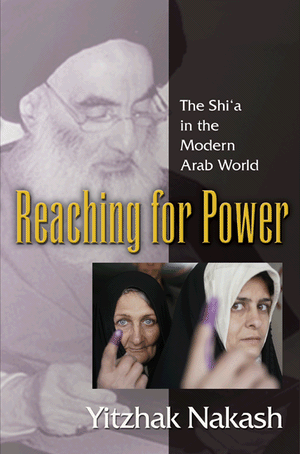
I shall write soon about the 5th Anniversary but I wanted to postpone that until the 9th of April, in the meantime I'll review this book since I just finished it.
Like me, Nakash is a non-Shi’i (Iraqi Jew) who seems to have developed a fascination with Shi’ism, he’s written a number of books on the subject, including the solid The Conversion of Iraq’s Tribes to Shiism, a book I found thoroughly researched, sourced and balanced, which led me to pick up this book, making it the second Naqash book I read.
The book is essentially a very informative country-by-country overview of Shia conditions beginning from the nation-state period in the Arab world, it outlines in painstaking detail the relationship between the state and Shi’i community in four gruesome chapters, beginning by Saudi Arabia, Bahrain, briefly touching on Kuwait [which it praises as the most Shia-tolerant], then jumping headlong into the informative Iraq and Lebanon chapters, before finishing with a brief opinion-recommendation.
One of the more fascinating aspects of this book is the illuminative insight it provides in the role different sects played in shaping current nation-states, before reading this book, I voiced the opinion on this blog or some other blogs that the clash between the Ba’ath and the Shia in the 1980s was in essence a clash between the tyrannical secular state and Pan-[Shi’i] Islamic theocracy, with the Sunni-Shia dimension being only secondary in the conflict. I can tell you now that this view is bullshit, the only definitive fixture in the struggle in Iraq is the Sunni-Shi’i dimension, but it often hides behind other ideologies, for example, while the Sunni ruling elite espoused Pan-Arabism, the Shia by and large were more than fearful of compromising their majority-status in Iraq by joining a Pan-Arab domain in which they will be marginalized as a minority, hence their own choice to embrace a modern ideology was the Communist Party, which I believe has less to do with any appeal of Marxism in the Shia community than it being the only modern ideology (as were the trends of times) strong enough to repel Pan-Arabism at the time ; thus, you can understand the amount of reverence the Shi’i community hold for Abdilkarim Qassim (the face-on-the-moon hoax was actually invented by Thawra (Sadr City now) residents after he was executed), the minority-status of the Sunnis compelled them to stress their Pan-Arab ideology so as to embrace their co-religionists and balance their number, often harping on the cultural ties of Shia with Persia, while the Shia preferred an isolationist policy that maintained their advantage and emphasized general Arab and Tribal values, which was what the Communists preached.
Ironically, the very same Pan-Arabism the Shia of Iraq found unappealing was doted upon by their Saudi co religionists, who sought to counterbalance the ideology of the Saudi state’s Pro-US Pan-Islamism (yeah) which had a strong adversary in Nasser’s Pan-Arabism at the time, basically, the Saudi Shi’is embraced any ideology that promises reform and change, here we see that the choice of ideologies in the Middle East was inspired not by the actual principles of said ideologies but the degree of adaptability they offer to persist the rights of respective communities.
Even more interesting is that while the notion in Pan-Arab Iraq was that the Shia are the separatist traitors, in Lebanon, the Sunnis were the ones labeled traitors to Lebanon because Lebanon was the isolationist country the Shias of Iraq desired ; the Christian-minority Maronites went out of their way to forge Lebanon against the demands of Sunnis to unite it with Syria, they designed Lebanon as a Phoenician non-Arab oasis of the oppressed in the sea of Islam, in fact, there are several eye-opening accounts of several botched president Bshara al-Khori projects, including siding up completely with Israel and resettling all the Shia of Jabal Amil in Iraq in order to increase the numbers of Christians.
The book is largely concerned with the modern politics, it doesn't explain for example why the Shia feel so estranged from the Sunnis when they're both Arabs, History-wise, it's informative and recommended, if anything, the reference index is a treasure trove of Arab-only books on the subject. Where it falls short is when Naqqash advocates his upbeat and optimistic opinion, Naqqash views the ascendancy of Shia as a potential reform palette in the Middle East, reading this book, sometimes you might be persuaded to think of Muqtada as a sharp, intelligent grand strategist, not a confused Nasrallah-wannabe with bad oral hygiene, Naqqash says that Shias have moved from confrontation to accommodation regarding the West, he adds that the only reason theocracy rose in full force is because of the lack of a civil alternative, and he doesn’t invest much in Iran or the idea of its possible dominance through the guise of Pan-Shi’ism, instead describing it as a country very persuaded by democracy and civil rights, he mentions the possibility of Iraqi civil war in a single line amidst his love-fest, of course, this book was written in 2005, so he might be excused a little in that regard. Personally, while I do believe that it is absolutely necessary for any meaningful democracy of any sort to emerge out of the Middle East that the oppressed sects get their say, I don’t see Shias as any better than Sunnis in the field of understanding the grasp of pluralism and multiculturalism, they can be just as barbaric, backward and resilient, if not more due to their history of oppression which forced them to go inward, if Shi’is were the majority and Sunnis were the minority, the results would be quite similar, as long as sentiments in the Middle East adopt a method of discourse that consists of dominating everything at all costs, then it’s hopeless.
The only way Shiism could stand a chance at being a platform for accommodation is the same reason why the Shia Ismaili Fatimid state in Egypt [which ruled a Sunni population] exhibited a larger degree of religious tolerance in its times, that is, self-conscious recognition of their own status as a minority, which prompts them to encourage freedom and liberty as necessary for their survival, in this case too, it is a fake democracy aimed only at escaping persecution and not genuine belief in equality and modern citizenship values.
Subscribe to:
Posts (Atom)