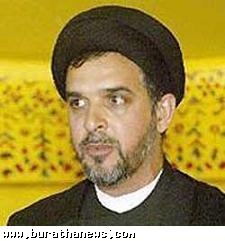
I have argued before that Sunnis and Shiites are irreparably hostile on religious terms, I still believe so, but I do believe that a good number of Iraqis from both sects would like nothing more than a peaceful co-existence. A key component towards achieving that goal is a meaningful respect of the opposite sect's religious values, which I believe is only possible under a secular rule that will dimnish the impact of religion on everyday life but also respect the religious rights while working neutrally towards skirting the hostile foundations of the two sects are built upon into a distinct Iraqi idetity, an impossible task of course because most Iraqis want a theocratic government, hence the dilemma, nevertheless I'll just babble on for the benefit of future "Iraqi" generations who might learn from the mistakes of their forefathers, how's that for being self-important.
Many of you might be surprised that I am a fan of Mulla Bassim al-Kahraba'ie, as a matter of fact, Mulla Bassim single-handedly played a huge role in my conversion from Western music into an appreciation of Middle Eastern modes of music. That respect grew out from a curiosity incurred by the ubiquitous presence of the Shia flagellation mega-hit "Ya Yom Ashoof Ei'tabak" everywhere in Iraq, which was endlessly satirized such as [here], and then it developed into an interest in the supernatural, enterainingly apocalyptic vision of Shiism ; you see, the problem with Sunni Islam is that it's stories are rather boring from the perspective of a story-teller, sure it does confirm Judeo-Christian stories of a prophet who talks to animals and the snakes of Moses but those are minor stories, as the principle concept largely center upon a worship of a single God and that's about it. On the other hand, Shiism is centered upon a very passionate
dramatic piece with lots of dark fantastical themes: there's a fascinating battle between Good
and Evil where Evil always wins, there's a centuries-asleep Hidden Wrath-Of-God Imam who will come back, resurrect all the bad guys and kill them, those apocalyptic visions easily stirred the Heavy Metal-, fantasy-, Gilgamish and Enkido-loving spirit within me, there's something ethereal when you listen to a story told in a larger-than-life mesmerizing melody about the righteous holy blood dripping from the cuffs of Musa al-Kazim by Haroon, in the process uplifting those holy men and their antagonists from normal eat-shit-sleep human beings into the mystery-shrouded Demigods in an Iron Maiden song.
Okay, okay, so Shias might be a little annoyed at my comparison to their beliefs with mythologies here, but my point is that I have grown a sense of appreciation for their rich
culture, in fact one of my things I want to do someday is visit Karbala or Najaf like Salam Pax did here (why is the blog's colors like this now?) just for the grandiose curiosity of it. In fact, Sunnis ave somehow recognized the huge impact of those Shia religious hymns in rallying solidarity and they have attempted to replicate it, they are stealing Shia eulgoies and are applying it to Saddam Hussein for example, and also they have a 'Mawlid' celebration (think Nusrat Ali Khan-like), but that is nowhere near as powerful as the Shiite ceremonies, and that is because their version of religion is still a pure simplistic veneration that refuses innovation "bidda3" and isn't as imaginative, it discourages iconization and frown upon any other form of worship than Qur'an recitals, in fact even the pillars of Sunni Islamic music comes from external sources, the most famous Muslim singer, dubbed "Muslim Bono", Sami Yusuf, is a British of Azeri (mostly Shia) origin who was born in Iran, but is for some reason Sunni (even that is in doubt). Another very famous song, Ya Tayba, hails from Indonesia and has Sufi roots (they even say Ya Ali in it), Sufism is a blurry form of Islam which stress Music and dancing as a form of being closer to God. it has many Shia influences but nothing of the complex traditions and stories which makes it offensive to the orthodoxy Sunnism.
Let's revisit Mulla Bassim again, in 2003, Bassim was singing in his "Symphony of Graves" about Saddam Hussein:
Kurd and Arab a victim,
Sunni and Shia altogether.
Sunni and Shia altogether.
in 2006, after the Askariya Shrines were demolished, the Mulla sang this hateful masterpiece (edited here, but Nawasib line can still be seen in the end):
O Mahdi, You have four vengeances,
Taim, Adi, Harb and Sakhar
The first took away Fadak from you
The second broke the rib of your mother
The third split open Ali's head
The fourth slaughtered the blood of Hussein
Should Hasan live with us
He would've been poisoned again
and Should Hussein be resurrected
They would have cut his neck again
Lo, Alas your grandfather is buried among the Nawasib!
"Grandfather" refers to the Askari shrines, which is in Samarra, a Sunni town, that is what he refers to by "buried among the Nawasib." In Shia lexicon, Nawasib is the most extreme form of insult you could bestow upon a person, it means a devout enemy of Shia. The poem is also unusual in the sense that it explicitly refers to the names of the First and Second Caliphs (although still somewhat coyly through their tribe names), an extreme rarity as they are usually hinted to as "the people" or just "them."
I find in this poetry a reflection of a more popular resentment, yes, even though the Shia doctrine is hostile to Sunnism, it tries to bury those conflicts so not to cause controversy. But when the Shia Arabs were not warmly accepted by their Arab neighbors, and when terrorists began to blow up Shia markets, culminating in an outright demolishion of a holy shrine, the Shias found less and less reasons to embrace the desire to keep this peace and to declare the ancient hostiliy more brazenly ; it's a reaction, not an action. The Sunnis in general should've been more receptive to Shiites, but they chose to be hostile and a hindrance.
On the other hand, the Shiites should not have announced their arrival to dominance with such a venegance. If the Baathis and the renegade al-Qaeda started to attack Shia indiscriminately, the Shia government gave the general Sunni population, both inside Iraq and outside it, more and more reasons to view the conflict as encompassing Wahhabi and Sunni alike. They basically
justified the Sunni fears that they will be marginalized even if they chose to participate, they
killed innocent civillians by the dozen just the same , and then there was the sloppy, sectarain-themed timing and execution of Saddam Hussein (a very stupid move then was made by Sistani's deputy, who called for Saddam to be executed between the shrines of Hussein and Abbas), the disbanding of the army, and the engulfing of Iraq into a perpetual mourning ceremony whose greatest concern was sealing off everyday life from one Ziyara to the next, another needless of demonstration that we are Shia and we are in power, so eat your heart out.
And this is why Iraq is fucked, because a theocratic government would often tend to aggravate the opposite sect as the difference between the two sects is hostile. This is especially true of Shiism because, like I said, its practices are more apparent, more encompassing, and are filled with dramas, ceremonies, and rituals, which would make the Sunnis alienated and indirectly remind them of those hostilies, on the other hand, regular Sunni Islam* on the other hand is just reading Qur'an and going to Friday prayers, and isn't offensive to any Shia figure.
What we need is a secular government that would realize the danger of religion on Iraq, a government that recognizes Shia dominance and practices but does not make it a perpetual all-encompassing feature of the state, a government that greatly enforces the identity of being an Iraqi before everything else, and the Shia slogans and murals that you will find everywhere if you go to Iraq today always serves to remind you that some people are 'less' Iraqi than others. It is my opinion that this state is impossible to create today, as to why, it's for another time.
For now, I dedicate this hymn to my Shia brothers, it's called Ajat al Aasreen, if anyone knows what this maqam is this please tell me because it sounds like a traditional Iraqi mode and I love it very much.
عجت العصرين و أسود الفضا من طحت يحسين يبن المرتضى
* Excluding probably Wahhabism, it also serves to remind oneself that the dominant form of Sunnism in the Ottoman times was Sufi, a trippy music-loving form itself.