as I'm sure you've noticed, I've finally installed Haloscan. I've been meaning to do so since forever but there was some problems with the automated install, so yesterday I finally had time on my hands to do it manually.
Yay.
Now let us ponder for a bit the all-too-familiar problem of the limits of freedom of speech, as it I have run into this problem myself recently on this blog.
You realize, of course, that freedom of speech is a difficult principle to uphold idealistically, the foremost implementation of said principle is, in the words of the great Trey Parker: "Either it's all in, or nothing's in." because, once you've given a particular group of people a preferential treatment, you would have eventually to submit to the wishes of every other group. Now, while I have banned some people from commenting here due to their repeatedly racist attitude (which they are oblivious to, most horrendously) towards a certain group of people to which I belong, I am obliged hereby to delete any other racist comment offensive to any group of people in the criteria. Eventually, the constraints would be too much so that commenting would become an inherently futile feature.
Which is what everybody seems to be doing, I have noticed that most of the big-gun bloggers end up eliminating their comments forum altogether as an unsatisfactory solution to that problem. Raed Jarrar did it, Riverbend, and most recently Angry Arab. This solution is flawed, but I find no other one that completely eliminates the problem as this one.
The world is bound with flawed realizations of freedom-of-speech, ِِِAnti-Semitism, for all intents and purposes, favors a certain group over others, so what's wrong if I uphold this flawed Anti-Semitism model (arabs are semites too) to my own use? But of course, that is no ideal solution, it is justification for my own flaw.
Another solution would be to remove the ban, but I cannot bring myself to it. On a personal note, I cannot stand them, I totally abhor their views, their ongoing campaign to blame everything on the inferiority of Iraqis, their racist, sly mockery of Arab-Muslim culture, among other things. and here is the problem, because I am certainly not going to feel offended by people who are anti-Christian or anti-Jewish ,or anti-anything else for that matter, but this ban prompts me to act just the same towards them. I don't feel like continuously arguing them, because, as I said earlier, it is futile on the long run.
What do you think?
I hope u get the reference of the title's post.
Friday, May 30, 2008


Wednesday, May 28, 2008
Sarafiya Bridge Re-Opened.

I can't believe it, it was as if from a parallel universe ; something actually was accomplished in Iraq - they have actually managed to reopen the Sarafiya Bridge. I am praying at the rate of 1000 prayers/hour that it doesn't prove me wrong and collapse because of cheap materials while some sleazy contractor is laughing his ass-cheeks somewhere far away from Iraq, I remember I was frothing mad when the bridge I passed countless times was destroyed a year ago by a terrorist attack. Shgad 3eb.
I remember how happy I was when our Iraqi team won [by the way, it has sucked balls recently in the World Cup qualification stage] but afterwards I found out that nothing really changed, we all love Iraq, and we want it to be something, unfortunately that something is still imaginary, and there isn't much to be optimistic about its realization in the long-run, but let us enjoy, for once, this moment in a silly larger-than-life fashion and say that the Iraqis are not just a random collection of sects but have gelled into becoming fully aware of their destiny as one nation and have had enough bloodshed. I liked Maliki yesterday, I never really criticized him, but I've always feared that he is marginal in reality. Let us hope, however silly and unrealistic our hope might be, that he proves us wrong. Thank you Abu Israa. Lak wuda3til abbas inta a7san zmal beehum.
This is good news indeed, I'm going to celebrate, I'll turn on Iraqi Jewish singer Salima Murad's Ala Shawati Dijala Murr (a song about Dijla (Tigris), which runs under al-Sarafiya), I can't adhrub talqaat here so I'll just adhrub jilikh, before I go to sleep. Good night. let's hope it's the last time Sarafiya will be reopened.
Tuesday, May 27, 2008
R.I.P. BlogIraq
In general, back-and-forth intra-blog discussions don't end up with a positive outcome, they are filled with long arguments that are hard to follow, and both sides will stubbornly stick to their side no matter what, however, for the benefit of the general population I would respond to Iraqi Bloggers Central's recent post, which was in itself a response to my earlier mockery of their supposedly all-encompassing knowledge of Muslim culture.
Mister Ghost, in a swashbuckling-ly glorious representation of American values of freedom and glory against the deep darkness of Islamic bigotry, starts with a big slice of bigotry hismelf: "I would like to defend myself against a couple of points by the deep-thinking but Iraqi-flawed Abbas." As if being "Iraqi" in itself is a disadvantage to the logical circuits of one's mental processes.
He still doesn't get my point, my post wasn't really an objection towards Quran-burning or whatever Rotten Gods is doing, even though regular Muslims might find it appalling, just as regular Christians would find Bible burning the same, I was only mocking his smug all-knowing attitude towards Arab-Muslim culture, which he clearly finds of no particular use to mankind.
Then, he condescendingly outlines White Man's superiority over mainstreamsandniggers Iraqis, including:
a) That all Iraqis were cowardly cogs inside the Baathist Caliphate. Mister Ghost, who has lived all his easy, comfortable life somewhere so removed from pain and suffering, has no real understanding of those concepts at all, he has no ability to understand that human beings might act differently in other environments, I wonder what Mister Ghost would have done if he was born and raised in as a German in Hitler-era Germany, or a Russian in Stalin's Russia, or an Iraqi in Baathist Iraq, the latter was nothing like present-day Iran, or Jordan, or Egypt (where people are actually trying to act up, btw), a country where you, your father, your entire family would be executed for the simplest joke. I don't think Mister Ghost would have acted anyway different, he would still rather live and make ends meet.
b) "Would anyone disagree that Iraqis have deeply-ingrained prejudices? LOL" That statement alone made me wonder about how old Mister Ghost actually is. How different are Iraqis from Germans, Americans, Russians, South Africans, Chinese, Tibetans in terms of having prejudices? He pontificates further:
c) Iraqis are expelling Christians. Funny, what does "Iraqis" here mean? it's as if not a single Muslim is being killed or deported in Iraq. What is the difference between Muslim expulsion death and Christian expulsion? Apparently, in the eyes of Mister Ghost, only Christian expulsion is worthy of attention.
d) That we are calling Christians "collaborators" and are expelling just like we did to the "Jews", here, Mister Ghost falls in several problems: first, I have never heard one Iraqi calling a Christian a "collaborator", actually, before I came to Amman, my pretty religious family's neighbor was an Iraqi Priest with his family, my mother (who wears a jubba) sent them a cake on Christmas and my brother and sister frequently played with their children, they got along with them much better than our current Iraqi Muslim neighbors, how is that for being flawed with terrible prejudices?
Also, he conveniently ignores the fact that Iraqi Jews were pretty much living quite the same as everyone else in Iraq until the state of Israel was born, i.e. the expulsion had a logical reason - not to mention that Jews were treated better in the Muslim Caliphate than they were in Medieval Europe, also, many Iraqi Jews actually wish to go back to Baghdad, which they miss as their true home, I would cite the Jewish author Samir Naqqash as an example. I also advise you to read some of British-Iraqi Jewish author Elie Kedourie's work.
I have called Layla Anwar a bigot previously, I apologize terribly, if she is a bigot, then at least she is direct and honest about it, and like I said about the whole Wafa Sultan thing : bigots balance each other out.
Personally, I don't tolerate bigots, so, and while I have previously issued a fatwa against their blog, it was slightly in jest, as of today, I ban all members (although Rhuslancia wasn't really bad, but I'm sorry) from commenting at my flawed, prejudiced, cowardly blog.
Mister Ghost, in a swashbuckling-ly glorious representation of American values of freedom and glory against the deep darkness of Islamic bigotry, starts with a big slice of bigotry hismelf: "I would like to defend myself against a couple of points by the deep-thinking but Iraqi-flawed Abbas." As if being "Iraqi" in itself is a disadvantage to the logical circuits of one's mental processes.
He still doesn't get my point, my post wasn't really an objection towards Quran-burning or whatever Rotten Gods is doing, even though regular Muslims might find it appalling, just as regular Christians would find Bible burning the same, I was only mocking his smug all-knowing attitude towards Arab-Muslim culture, which he clearly finds of no particular use to mankind.
Then, he condescendingly outlines White Man's superiority over mainstream
a) That all Iraqis were cowardly cogs inside the Baathist Caliphate. Mister Ghost, who has lived all his easy, comfortable life somewhere so removed from pain and suffering, has no real understanding of those concepts at all, he has no ability to understand that human beings might act differently in other environments, I wonder what Mister Ghost would have done if he was born and raised in as a German in Hitler-era Germany, or a Russian in Stalin's Russia, or an Iraqi in Baathist Iraq, the latter was nothing like present-day Iran, or Jordan, or Egypt (where people are actually trying to act up, btw), a country where you, your father, your entire family would be executed for the simplest joke. I don't think Mister Ghost would have acted anyway different, he would still rather live and make ends meet.
b) "Would anyone disagree that Iraqis have deeply-ingrained prejudices? LOL" That statement alone made me wonder about how old Mister Ghost actually is. How different are Iraqis from Germans, Americans, Russians, South Africans, Chinese, Tibetans in terms of having prejudices? He pontificates further:
c) Iraqis are expelling Christians. Funny, what does "Iraqis" here mean? it's as if not a single Muslim is being killed or deported in Iraq. What is the difference between Muslim expulsion death and Christian expulsion? Apparently, in the eyes of Mister Ghost, only Christian expulsion is worthy of attention.
d) That we are calling Christians "collaborators" and are expelling just like we did to the "Jews", here, Mister Ghost falls in several problems: first, I have never heard one Iraqi calling a Christian a "collaborator", actually, before I came to Amman, my pretty religious family's neighbor was an Iraqi Priest with his family, my mother (who wears a jubba) sent them a cake on Christmas and my brother and sister frequently played with their children, they got along with them much better than our current Iraqi Muslim neighbors, how is that for being flawed with terrible prejudices?
Also, he conveniently ignores the fact that Iraqi Jews were pretty much living quite the same as everyone else in Iraq until the state of Israel was born, i.e. the expulsion had a logical reason - not to mention that Jews were treated better in the Muslim Caliphate than they were in Medieval Europe, also, many Iraqi Jews actually wish to go back to Baghdad, which they miss as their true home, I would cite the Jewish author Samir Naqqash as an example. I also advise you to read some of British-Iraqi Jewish author Elie Kedourie's work.
I have called Layla Anwar a bigot previously, I apologize terribly, if she is a bigot, then at least she is direct and honest about it, and like I said about the whole Wafa Sultan thing : bigots balance each other out.
Personally, I don't tolerate bigots, so, and while I have previously issued a fatwa against their blog, it was slightly in jest, as of today, I ban all members (although Rhuslancia wasn't really bad, but I'm sorry) from commenting at my flawed, prejudiced, cowardly blog.
Monday, May 26, 2008
Boredom

The best period about anything is the beginning.
This is one of the few things I am absolutely sure about. I still remember the barely stifled joy I had while my father was installing our new Satellite receiver a few months after the end of the war. It was an incredible feast of all sorts of pandemonium after spending years watching Saddam's plain-vanilla TV. For days I sat mesmerized by the new powers of the blessed Remote Controller, flicking channel after channel and watching full-episodes of programs I have previously only heard about or saw snippets of as our ministry of misinformation felt like showing us, and of course I enjoyed secretly switching to the European Hotbird at night to have a guilty glimpse at some naked epidermis of the elusive female species.
In a few weeks I was bored, of the 399 choices I had I only ended up watching sitcoms such as Friends, and soon it hit me that I missed Saddam's TV in an inexplicable fashion, at first I didn't know why, but soon I came to realize that I felt this way because the dream-fantasy had been shattered : when you're imprisoned, sick, poor, whatever, you would have your revenge reveling about the wonders of the world you don't have : freedom, the heaven in the afterlife, wealth, that there's something out there that's better than this crap - in my case some magical land where the television has 399 channels and everybody is happy, but now that I have that magical land in my living room it turns out that there's nothing really special about it, if anything, it throws you in the middle of an awful chaos of channels that is going to take you forever to sort out.
the same disappointment applies to any number of things, meeting someone new, discovering God, masturbation, drugs, sex, pool, music and the all-encompassing life itself: for many people, childhood is the period they feel most nostalgic for. You spend a lot of time absorbing this wondrous world everyday, oblivious to the more horrible things in life such as responsibility,character, and developing deep feelings. I think discovering God has a slightly higher boredom curve because the actual reward is only granted when you pass away, keeping you forever tantalized, but I'm sure that the afterlife is going to be one hell of a boring dud (just imagine Teletubbies having sex and drinking wine forever and you'll see what I mean. Is that what we all really want?)
Everything is best when you're just getting started, when the excitement of adventure still hasn't turned into the routine of habit. When you listen to CDs not because you have to cuz you're a prestigious Metalhead who's forever looking for the next best riff out of duty, but because it excites you and kicks you in the ass. Have you thought about why all the great musicians, bar none, eventually settle into decline after hitting their peak? Their desire fades, replaced by a new desire, the inertia of habit and money, but mostly it's the boredom that engulfs both the artist and his fanbase. Human beings are too easily bored, and as a rule human creativity is limited in reinventing itself. The greatest thing Cobain did was kill himself before expiring into mediocrity, I'm sure he did it willingly.
I don't think anyone can be perpetually in love with anything, in the end it all resolves into boredom, or normalcy if you want to call it that, and you either reminisce about your past selectively or, if you have the guts, begin planning new conquests.
I read that Sweden has some of the highest suicide rates in the world, I found that to be hilariously funny. Here we are, the miserable Iraqis, bribing, enduring great difficulties, begging, being hauled as six-packs or twelve-packs in carton boxes with little holes to breath from, all just to get into your never-land of milk and honey, O Swedes, and you dumbfucks have the nerve to deny yourself that heaven voluntarily, have you no respect for our feelings?!? this got me thinking: what is it all about? what are we trying hard so for? look at them, they have the 2nd highest development index in the world and they kill themselves, why are we toiling ourselves then, for what, to provide food for our family and then die of terminal normalcy?
Have you asked yourself, why are human beings so into killing and raping each other? Why can't we all just Heal The Worllllllld, Make it a better plaaaaace, for you and for me and the entire human race? Let me tell you, because it's boring and stupid that way. Life is too boring without rape, murder, crime, death, loud music, war. One can never have an action movie without the villain, satan, jews, muslims, shia, the enemy is important for ourselves to not collapse into total boredom. Human beings are greedy and unjust by nature, always searching for more, because they are never content with what they have ; a forever crusade to famish the hungry well that will never be extinguished.
for what drives mighty conquerors such as Alexander the Great, or Khalid bin al-Walid to conquer all these lands if anything but their hollow souls?
To Be Continued...if I'm not too bored.
Saturday, May 24, 2008
More al-Arabiya Watch
Bizarrely, Only a week after Mohammed "Artist of the Arabs -except that he thinks of himself as Saudi first" Abduh, who in between 90 minutes of incoherent mumbling gave Prophet Mohammed a Saudi passport on the Saudi MBC channel, he appeared on sister news channel al-Arabiya in the program Idha'aat
Idhaa'at is an excellent Gulf-centric reformist-bent program that interviews personalities often considered "controversial" ranging from intellectuals, writers, politicians, and poets. So what does Abduh, a socially and politically irrelevant singer who messed up answering a question doing here? and if that's not a dead giveaway, the first question anchor Turki ad-Dakhil asked him was to apologetically explain the incident, and he explained it like a robot...without stuttering.
On al-Arabiya.net : Aside from the ongoing anti-Hezbollah campaign, al-Arabiya runs an article on Gambia's president, who threatened to behead all homosexuals in Gambia. I can only describe the comments section as "happy lynching (of homosexuals, that is)."
Idhaa'at is an excellent Gulf-centric reformist-bent program that interviews personalities often considered "controversial" ranging from intellectuals, writers, politicians, and poets. So what does Abduh, a socially and politically irrelevant singer who messed up answering a question doing here? and if that's not a dead giveaway, the first question anchor Turki ad-Dakhil asked him was to apologetically explain the incident, and he explained it like a robot...without stuttering.
On al-Arabiya.net : Aside from the ongoing anti-Hezbollah campaign, al-Arabiya runs an article on Gambia's president, who threatened to behead all homosexuals in Gambia. I can only describe the comments section as "happy lynching (of homosexuals, that is)."
Thursday, May 22, 2008
Universities in Iraq
You think the Sadrists are the only crazies in town? Dean of Badrist-controlled Baghdad University issues the following: "Female students are not to be allowed to wear provocative clothing in respect of the sanctity of the college campus." I don't really understand what he means by "provocative clothing," I've been searching for it all my college life, but most of the girls wear hijab and the rate has been increasing because of peer pressure and/or the security situation, the others who don't wear hjiab are modest by comparison to what girls wear, say, here, I guess "provocative clothing" can be made to fit any number of combinations, with the inevitable result of Jubbafication.
Aside from setting fashion trends, the Badrists in Baghdad University have also previously killed Isam al-Rawi, a moderate Sunni doctor there.
other universities in Iraq: al-Mustansiriya University is Sadrist controlled, (it opposes the Mustansiriyya public square which has been defiled by, ironically, an ugly Hakim tribute.) at one point they didn't allow mobile phones and enforced strict dress codes.
Technologia University and Nahrain University seem to be a little freer. I was once joking around with a cousin of mine, who attended al-Nahrain Medical University (in Kadhimiya), it's an old joke I caught from hanging out with the southern guys at the hostel. You rename your name in his mobile phone's contact list to any given holy character, sometimes Allah, Imam Ali, Saddam or Sa'adi Il Hilli and call him to watch the look on his face. So I changed my name to Imam Ali but unfortunately I forgot to call him, so my name was left as Imam Ali until the Sadrist guards at the university took one long, furious look at it (in some universities you have to relinquish your phone at the entrance, not ours thankfully,) amazingly, they didn't kill the poor bastard, the guy told them it was a prank by a Nasibi cousin, much to the fury of my aunt's Shi'i husband.
in other news, The Olympic Committee of Iraq has been disbanded.
Aside from setting fashion trends, the Badrists in Baghdad University have also previously killed Isam al-Rawi, a moderate Sunni doctor there.
other universities in Iraq: al-Mustansiriya University is Sadrist controlled, (it opposes the Mustansiriyya public square which has been defiled by, ironically, an ugly Hakim tribute.) at one point they didn't allow mobile phones and enforced strict dress codes.

Technologia University and Nahrain University seem to be a little freer. I was once joking around with a cousin of mine, who attended al-Nahrain Medical University (in Kadhimiya), it's an old joke I caught from hanging out with the southern guys at the hostel. You rename your name in his mobile phone's contact list to any given holy character, sometimes Allah, Imam Ali, Saddam or Sa'adi Il Hilli and call him to watch the look on his face. So I changed my name to Imam Ali but unfortunately I forgot to call him, so my name was left as Imam Ali until the Sadrist guards at the university took one long, furious look at it (in some universities you have to relinquish your phone at the entrance, not ours thankfully,) amazingly, they didn't kill the poor bastard, the guy told them it was a prank by a Nasibi cousin, much to the fury of my aunt's Shi'i husband.
in other news, The Olympic Committee of Iraq has been disbanded.
Wednesday, May 21, 2008
Practical Uses of Quran
As you know, some confused soldier has made Bush apologize for Dolkat Ra'ees Wuzaaraa al-Maliki because he turned a Quran into target practice.
How about some more practical uses of Quran in daily life?
This guy protests Iranian theocracy by Qur'an burning, okay, but then comes the "Iraqi" Bloggers Central - who think that Layla Anwar (a blogosphere synonym for Rabid) is the perfect definition of what an Iraqi should be) and they enlighten us with their supreme understanding of Arab/Muslim culture : "to light a Quran on fire is a horrendous act of blasphemy for Muslims."
Could somebody please tell the poor sods (and our brave protester) that Qur'an burning is the recommended Islamic method to dispose of a Qur'an?
How about some more practical uses of Quran in daily life?
This guy protests Iranian theocracy by Qur'an burning, okay, but then comes the "Iraqi" Bloggers Central - who think that Layla Anwar (a blogosphere synonym for Rabid) is the perfect definition of what an Iraqi should be) and they enlighten us with their supreme understanding of Arab/Muslim culture : "to light a Quran on fire is a horrendous act of blasphemy for Muslims."
Could somebody please tell the poor sods (and our brave protester) that Qur'an burning is the recommended Islamic method to dispose of a Qur'an?
Monday, May 19, 2008
al-Arabiya
After reading Angry Arab, I came to realize the bias of Saudi al-Arabiya, who I thought was fairly objective before. it's certainly more coy than the fire-and-brimstone traditional Arab-Muslim views of al-Jazeera, but just look at the front page: championing the weak Hariri with headlines such as "Progress being made in Doha in spite of setbacks," while waging a complete war against Hezbollah with the featured opinions: "This is why the Hezbollah coup failed," a simpler and more obvious inclination of their bias is the article about Saudi singer Mohammed Abduh's recent interview on the "Godfather" talk show, (for some reason, Abduh is called the "Artist of the Arabs" although I don't think he's really heard outside the Gulf much), in that interview, Mr. Abduh lambasted Iraqi Kadhum al-Sahir, another frequently cited "Artist of the Arabs" but possibly the most successful pan-Arab artist in recent decades. while al-Arabiya mentions this in its headline as the major controversy of the show, they pass in silence the real controversy which is all over other forums, in which the Saudi singer called the Prophet Muhammed a "Saudi." live on air.
Saturday, May 17, 2008
Thursday, May 08, 2008
New Blog
A newly-discovered blog by Baghdad Kassakhon [Storyteller], who is a journalist in Baghdad, has a post about the suffering of the Iraqi staff of the Associated Press.
Friday, May 02, 2008
Crisis Group, Muqtada's Greatest Hits DVD
International Crisis Group publishes two new articles about Iraq: The New Sunni Landscape, which explores the al-Qaeda's fall from grace in the Sunni community and the emergence of Sahwa, and the Need for a New Political Strategy. I've only read the first one so far and it's as informative and detailed as the previous Crisis Group reports, describing how did al-Qaeda fail and the motives of the Sahwa Tribal militas and their interaction with the US, the government and rival Sunni parties.
****
al-Rafedain.net, a Shi'i website with a strong anti-Sadrist bent has been uploading vidoes defaming Muqtada and the Mahdi Army for a long time, their latest is "Shathaat Muqtad'iyya" (Muqtaadi Fumbles), which collects the funny, crude and embarassing things Muqtada has said and done in a three-part YouTube series. Particularly interesting is Muqtada meeting his henchmen in the 2nd video, the similarity to you-know-who is uncanny, minus the crying Ya Booooya guy.
****
al-Rafedain.net, a Shi'i website with a strong anti-Sadrist bent has been uploading vidoes defaming Muqtada and the Mahdi Army for a long time, their latest is "Shathaat Muqtad'iyya" (Muqtaadi Fumbles), which collects the funny, crude and embarassing things Muqtada has said and done in a three-part YouTube series. Particularly interesting is Muqtada meeting his henchmen in the 2nd video, the similarity to you-know-who is uncanny, minus the crying Ya Booooya guy.
Sunday, April 27, 2008
Arabs First Created...
COMMERCIAL JINGLES!!!!!

قل للمليحة في الخمار الأسود ماذا فعلت بناسك متعبد؟
قد كان شمر للصلاة ثيابه حتى وقفت له بباب المسجد
ردى عليه صلاته وصيامه لا تقتليه بحق دين محمد
قد كان شمر للصلاة ثيابه حتى وقفت له بباب المسجد
ردى عليه صلاته وصيامه لا تقتليه بحق دين محمد
the hero of this story is a poet called Miskin al-Darmi, who is an Umayyad-era Poet, who died in 90 AH.
SCENE: Medina.
al-Darmi in his house, with an Iraqi friend named Sulayman al-Baghdadi.
Darmi: Good going, dude, we managed to stay the whole night worshiping in the mosque.
Baghdadi: You know man, I wasn't worshiping in sincerity, but I had nothing else to do.
Darmi: What, you sold all your stock?
Baghdadi: Well, yes, except for the black burqaas, which constitute 4/5 of my goods.
Darmi: Why did you buy so much of these?
Baghdadi: Well because women in Iraq have taken it in fashion these days, so I thought it would be fashionable for the women of Medina.
Darmi: So what are you going to do now?
Baghdadi: Man, I'm in such a bad streak, ever since I stopped getting drunk at parties I've never seen anything good come to me. I've put all my money in these veils and now all I got to do is go back to Iraq and declare bankruptcy.
Darmi: Wait, I've got just the thing for you.
The next day al-Darmi sheds down his worshiping robes and dons partying clothes. his wife Jaleela is dumbfounded.
Jaleela: What the fudge are you doing? What do you think people are going to say?
Darmi: They'll say: al-Darmi reverted back to his old indecent ways and abandoned the path of worship.
Jaleela: and you like that?
Darmi: Whatever, I've decided to go back to what I was, it's more like me.
Jaleela: Woe to you!
Darmi: Don't worry, I'll be back poring over the Qur'an in no time.
Jaleela: Yeah right, you're going to spend your days writing indecent love poems and odes to those sultry concubines and then you come to me late at night, drunk and haggled, no sir, I'm going to my parents' house.
A party in the house of Abu Ayman, his concubines are led by the Singer Lamyaa, who sings some verses of al-Darmi's
Abu Ayman: Hit them with the new tune, Lamyaa.
Crowd: Yes, please, we want the new hit tune.
Lamyaa: I'm not going to sing it until I get the black burqaa.
Abu Ayman: I've had the boy go pick it up since early morning, and I don't know why it took him so long.
Ibn Suraij The Oud player: Here he comes at last!
Boy: Here's the black Burqaa, sir.
Abu Ayman: God curse your black face, what took you so long?
Boy: My good sir, look at my clothes, they're torn from the severe crowding and fights I've had to get into in order to get this burqaa. Everybody in town is buying those burqaas from the Iraqi merchant.
Ibn Surayji: So now you have your burqa, Lamyaa.
Lamyaa (dons it): How do I look in this?
Abu Ayman: By God! I never thought a black Burqa would look this good on anyone.
Crowd: So hit us with the tune now.
Lamyaa sings and Ibn Surayj plays:
Ask that beauty in the black burqa
What has she done to this obedient saint?
He was getting ready to pray, yet
her sight by the mosque door, made him faint
Leave him to his fasting and his prayers
By Mohammed's religion! leave him to his restraint
What has she done to this obedient saint?
He was getting ready to pray, yet
her sight by the mosque door, made him faint
Leave him to his fasting and his prayers
By Mohammed's religion! leave him to his restraint
Abu Ayman: Dance to it Lamyaa, it's made for dancing!
Lamyaa re-sings the verses while dancing, getting everybody visibly excited.
***
Darmi: Come back to me Jaleela, I've abandoned my marauding ways.
Jaleela: Look at this hypocrite, now that he's made a mockery out of himself he wants me back!
Her mother: Yes, everybody is talking about him these days.
Her father: Why did you do this to yourself?
Darmi: I'll tell you why.
Somebody outside sings: Ask the beauty in the black burqaa/what has she done....
Jaleela: Listen to this mother! Look, why don't you go back to your black burqaa beauty and leave me alone.
Darmi: There is no such girl, don't you people know the Iraqi merchant Sulayman? Haven't you seen that every woman in town has bought his Iraqi black burqas until there's none left?
Jaleela's father: Yes, even your wife begged me to buy one for her.
Darmi: Really? you wanted to be the Black Burqa Beauty yourself?
Jaleela: No, but I saw everybody do it so I did it myself.
Darmi: You see? I did what I did only so that I can help my Iraqi friend sell his undesirable black burqas! He's even sent for his dealer in Iraq to bring him more of them, they're selling like hot cakes.
Translated from the play by Ahmed Ali Bakthir, which is based on a true story.
The verses are famous, and they're still sung until today, most recently by an Egyptian fusion? band with some western influences called Wust il Balad.
This is the first installment of my Arabs First Created series.
Thursday, April 24, 2008
Batatu: Chapter 3 : Geographic Distribution of the Principal Racial-Religious Groups
[this chapter was especially illumantive to me regarding the question of Sunni-Shi'i distribution in old Iraq (before the 1800s) and what did "Iraq" exactly mean at the time]
Iraq may be said to have been, in the time of the monarchy, divided into three religious zones.
One of these zones, the most populous, was and remains the home of Shiism. it covers all the provinces to the south of Baghdad. In its ethnic composition it is Arab except for concentrations of Iranians in Basrah and the Holy Cities of Najaf and Karbala. Its Shiism is not unbroken. Here and there it is interspersed with islands of Sunnism, which are urban in character and, in their size, inconsiderable, except in Basrah and Nasiriyyah, where there are strong Sunni minorities, and in the town of Zubair, southwest of Basrah, which is entirely Sunni.
A second religious zone, embracing Arab-inhabited valleys of the Euphrates above Baghdad and of the Tigris between Baghdad and Mosul, is the domain of Sunnism. Here only small Shii minorities at Dujail, Balad, Samarra, and a string of Turkmen settlements, some of which are Shi'i as in Tal Afar and Toz Khomatu, breach the Sunni continuity.
The third religious zone conincides with the Kurdish rain-fed mountain crescent in the north and northeast of Iraq. This zone is also Sunni, but unlike the Sunni Arab region, it was in the period of monarchy permeated by mysticism and by its practitioners, the Sufis. This is not to say that there were no traces of Arab Sufism, however, in monarchic days had none ouf the outward vigor of Kurd mysticism.
EXPLANATIONS FOR THIS RELIGIOUS CONFIGURATION
Nearly at thousand years ago, Abu Bakr al-Khawarizmi (d 993) envied the people of Iraq because, as he put it, "in their midst are the tomb-sanctuaries of [Ali]...and of Hussein, and because Shiism is Iraqi." At the time the name Iraq referred not to the territory of present day Iraq, but only to that part which lay south of a line connecting Anbar (or according to another view, Haditha) on the Euphrates and Tikrit on the Tigris, that is, it coincided, except for Baghdad and areas north of Baghdad, with the abode of the Shi'is.the heart of the sect was then, as now, the Middle Euphrates, the role of the Buwayhids in Baghdad (from 945 t o1055) and al-Mazyad of Bani Asad from Hilla to Basra (1012 to 1150) helped or consolidated the advance of Shi'i principles. So did also the power that the Shii Arab dynasty of the Musha'sh' Saadah wielded from the outskirts of Baghdad to the Gulf in the middle of the fifteenth century. But before and after that time the country passed through a succession of conquests: the Euphrates and Tigris changed their main beds ; medieval towns, like Wasit and Madai'n disappeared, new towns, like Amara and Nasiriyah came into life, old tribes were scattered or subdued, and new tribes from Arabia moved into the river valleys, Yet in the midst of all the vicissitude and instability one feature persisted: the overwhelmingly Shi'i character of this zone. How can one account for this Shii continuity, particularly in the face of long centuries of apparent Sunni dominance, the dominance of the Ottoman Turks (1534-1622, 1638-1917) and their nominal vassals, the Georgian Mamluks (1749 - 1831)??
Apart from the power of persistence natural to religions and in particular to aggrieved sects, one obvious factor making for the perpetuation of Shi'i influence was :
[1] the presence of the Shii sanctuaries of Najaf and Karbala, and Shii schools at Najaf and Hillah.
[2] The commercial and religious intercourse that the Shias of Iraq maintained, if interruptedly, with Shi'i Persia.
[3] The contagion of the environment, Bedouin tribes who moved into the Shi'i zone - and Islam sat lightly on the Bedouins - tended in time, ti wold appear, to adapt themselves to its beliefs and practices.
[4] The missionary zeal of the mumans, who were itinerant men of religion.
It may be wondered how Shii conversions took place seemingly under the very nose of the Sunni government, the explanation is simple. During the greater part of the Ottoman period the write of the authorities ran precariously outside the main towns.
[5] The conversions may have even come about on account of the government: the tribes' intolerance of government - any government. and their association of government with oppression, plus the fact that the government was Sunni, may have eased the task of the mumans and the transition to Shiism.
The government accorded the Shi'is full liberty to make their devotions in their own manner in all the places that they considered sacred, apparently because it stood to gain from the flow of pilgrims to Iraq. But in all other places, as in Basrah or in Baghdad proper, they were denied the free exercise of their religion. This rule must have been relaxed in the course of the later part of the nineteenth century, under the monarchy the religious freedom of the Shiis became complete.
In turning to the Sunni Arab zone, the thing that catches attention is that Shiism never penetrated it in strength, while a Shii dynasty, the Hamdanis wielded authority in Mosul between 905 and 979, but it hardly made a dent in the Sunni loyalty of its inhabitants. An attempt to encourage Shiism by Badr-ud-Din Lulu, a slave who ruled Mosul for about forty years in the first half of the 19th century, failed to evoke any response. with minor exceptions, the whole region remained steadfast in its attachment to Sunnism down to our own time. Perhaps the most crucial explanation for this is the fact that, in their economic relationships, the regions of Mosul and the upper Euphrates were oriented toward Sunni Syria and, in a lesser degree, toward Sunni Turkey. Indeed, it would not be going too far to say that in the days of the monarchy the people of Mosul were closer in outlook and temperament to the Arabs of Syria, specficially of Aleppo, than to the Arabs of central and southern Iraq. (True, even the Mosuli accent, which I speak since I'm half-Mosuli, has more similarity with the softer Levantine dialects of Arabic than the harsher, more tribal accent of Iraq proper and the Gulf.)
Iraq may be said to have been, in the time of the monarchy, divided into three religious zones.
One of these zones, the most populous, was and remains the home of Shiism. it covers all the provinces to the south of Baghdad. In its ethnic composition it is Arab except for concentrations of Iranians in Basrah and the Holy Cities of Najaf and Karbala. Its Shiism is not unbroken. Here and there it is interspersed with islands of Sunnism, which are urban in character and, in their size, inconsiderable, except in Basrah and Nasiriyyah, where there are strong Sunni minorities, and in the town of Zubair, southwest of Basrah, which is entirely Sunni.
A second religious zone, embracing Arab-inhabited valleys of the Euphrates above Baghdad and of the Tigris between Baghdad and Mosul, is the domain of Sunnism. Here only small Shii minorities at Dujail, Balad, Samarra, and a string of Turkmen settlements, some of which are Shi'i as in Tal Afar and Toz Khomatu, breach the Sunni continuity.
The third religious zone conincides with the Kurdish rain-fed mountain crescent in the north and northeast of Iraq. This zone is also Sunni, but unlike the Sunni Arab region, it was in the period of monarchy permeated by mysticism and by its practitioners, the Sufis. This is not to say that there were no traces of Arab Sufism, however, in monarchic days had none ouf the outward vigor of Kurd mysticism.
EXPLANATIONS FOR THIS RELIGIOUS CONFIGURATION
Nearly at thousand years ago, Abu Bakr al-Khawarizmi (d 993) envied the people of Iraq because, as he put it, "in their midst are the tomb-sanctuaries of [Ali]...and of Hussein, and because Shiism is Iraqi." At the time the name Iraq referred not to the territory of present day Iraq, but only to that part which lay south of a line connecting Anbar (or according to another view, Haditha) on the Euphrates and Tikrit on the Tigris, that is, it coincided, except for Baghdad and areas north of Baghdad, with the abode of the Shi'is.the heart of the sect was then, as now, the Middle Euphrates, the role of the Buwayhids in Baghdad (from 945 t o1055) and al-Mazyad of Bani Asad from Hilla to Basra (1012 to 1150) helped or consolidated the advance of Shi'i principles. So did also the power that the Shii Arab dynasty of the Musha'sh' Saadah wielded from the outskirts of Baghdad to the Gulf in the middle of the fifteenth century. But before and after that time the country passed through a succession of conquests: the Euphrates and Tigris changed their main beds ; medieval towns, like Wasit and Madai'n disappeared, new towns, like Amara and Nasiriyah came into life, old tribes were scattered or subdued, and new tribes from Arabia moved into the river valleys, Yet in the midst of all the vicissitude and instability one feature persisted: the overwhelmingly Shi'i character of this zone. How can one account for this Shii continuity, particularly in the face of long centuries of apparent Sunni dominance, the dominance of the Ottoman Turks (1534-1622, 1638-1917) and their nominal vassals, the Georgian Mamluks (1749 - 1831)??
Apart from the power of persistence natural to religions and in particular to aggrieved sects, one obvious factor making for the perpetuation of Shi'i influence was :
[1] the presence of the Shii sanctuaries of Najaf and Karbala, and Shii schools at Najaf and Hillah.
[2] The commercial and religious intercourse that the Shias of Iraq maintained, if interruptedly, with Shi'i Persia.
[3] The contagion of the environment, Bedouin tribes who moved into the Shi'i zone - and Islam sat lightly on the Bedouins - tended in time, ti wold appear, to adapt themselves to its beliefs and practices.
[4] The missionary zeal of the mumans, who were itinerant men of religion.
It may be wondered how Shii conversions took place seemingly under the very nose of the Sunni government, the explanation is simple. During the greater part of the Ottoman period the write of the authorities ran precariously outside the main towns.
[5] The conversions may have even come about on account of the government: the tribes' intolerance of government - any government. and their association of government with oppression, plus the fact that the government was Sunni, may have eased the task of the mumans and the transition to Shiism.
The government accorded the Shi'is full liberty to make their devotions in their own manner in all the places that they considered sacred, apparently because it stood to gain from the flow of pilgrims to Iraq. But in all other places, as in Basrah or in Baghdad proper, they were denied the free exercise of their religion. This rule must have been relaxed in the course of the later part of the nineteenth century, under the monarchy the religious freedom of the Shiis became complete.
In turning to the Sunni Arab zone, the thing that catches attention is that Shiism never penetrated it in strength, while a Shii dynasty, the Hamdanis wielded authority in Mosul between 905 and 979, but it hardly made a dent in the Sunni loyalty of its inhabitants. An attempt to encourage Shiism by Badr-ud-Din Lulu, a slave who ruled Mosul for about forty years in the first half of the 19th century, failed to evoke any response. with minor exceptions, the whole region remained steadfast in its attachment to Sunnism down to our own time. Perhaps the most crucial explanation for this is the fact that, in their economic relationships, the regions of Mosul and the upper Euphrates were oriented toward Sunni Syria and, in a lesser degree, toward Sunni Turkey. Indeed, it would not be going too far to say that in the days of the monarchy the people of Mosul were closer in outlook and temperament to the Arabs of Syria, specficially of Aleppo, than to the Arabs of central and southern Iraq. (True, even the Mosuli accent, which I speak since I'm half-Mosuli, has more similarity with the softer Levantine dialects of Arabic than the harsher, more tribal accent of Iraq proper and the Gulf.)
Wednesday, April 23, 2008
Hanna Batatu, Iraq : Social classes.
I have finally resigned and began the exhausting task of reading the mammoth "phonebook" of Hanna Batatu about Iraq, (apx. 1300 pages, with fine letters), I shall jot down some notable paragraphs on my blog as I progress through it:
P. 17, DIVERSITY OF IRAQIS:
P. 17, DIVERSITY OF IRAQIS:
Of course, the more conscious of the townsmen thought themselves as part of the realm of Islam, and Islam's ideals, though denuded of much of their old vigor, tended to rescue them to some extent from their localism and associate them with their brother Muslims within and beyond the confines of the Ottoman Empire. But Islam in Iraq was more a force of division rather than of integration. It split deeply Sunni and Shi'i Arabs, socially they seldom mixed, and as a rule they did not intermarry. To the strict Shi'is, the government of the day - the government of the Ottoman Sultan that led Sunni Islam - was, in essence, a usurpation. In their eyes, it had not the qualification to even execute the laws of Islam. They were, therefore, estranged from it, few caring to serve it or attend its schools.Of course, today things are much different, mostly thanks to the pseudo-secular period of modern-day ideologies such as Pan-Arabism and Communism, there is social intermingling and intermarriage, although today, with the full-force resurgence of old Islamic models and the hostilities along it, it seems the problems are largely the same, except they got perhaps a little uglier with all that sly decades-long maneuvering, marriages are being broken apart and friends are re-examining their relationships. Let's hope for the next episode.
Friday, April 18, 2008
Government Aims for Muqtada's Balls
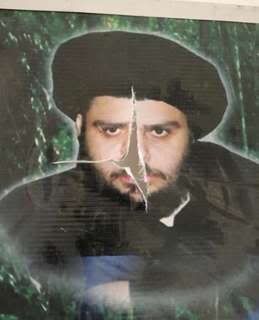
It seems that the guys really mean it this time around, they're really intent on nailing Shibil al-Hawza by his firebreathing firebrand nostrils, not only are they trying to forming Shahwa (Shi'i-Sahwa) councils inside the city that carries his father's name, but they're pulling all the guns : first a National Security Council that bans all militas [which really means just the Mahdi Army because Badr is the government now] and they're also wiping the dirt off the case of Muqtada's First Blood: Sayyid Abdul-Majid al-Khoei.
Two days ago, I watched an al-Khoei family member on al-Arabiya, he said that Muwaffaq al-Rubiaye came to talk to him about reopening the case, he seemed a little irritated at all involved, first he said that al-Khoei's case was never closed in the first place so that is shall be reopened, which directly contradicts what Rasim al-Marwani, a Sadrist cultural advisor, who repeatedly said that al-Khoei family themselves had "dropped the case which was setted in good will." and second he said that too many people have used al-Khoei's murder as political leverage, which is of course a direct jab at Ibrahim al-Jaffari's stint as PM in 2005 during which he ignored the murder due to the backing of the Sadrists which directly gave him the PM position, but he could have also been referring to this recent request by al-Rubaiye, especially as he didn't really seem to be supportive of it and seemed rather annoyed at all of them.
Another al-Khoei family member, Hayder al-Khoei, writes in his blog Eye Raki about this recent development, expecting an ominous showdown (of course, being a member of al-Khoei family it's understandable for Mr. Eye Raki not to be really objective about anything involving the man who killed his father, that is if he is indeed Hayder the son of Sayyid Majid, but re-reading Eye Raki's blog with this fact in mind the guy seems to be incredibly reasonable and objective about Iraq in general, and that is damn impressive considering his family is an extremely respected religious family which is expected to be subjective, to say the least, he is much better than other Iraqi Shi'i (and Sunni) blogs.)
Everybody in the government, including the Sunnis, and most recently, Iran, have supported the government against Muqtada, who has came back to Najaf ; recent news items talk about Basra breathing a little air after months of religious monkeybrains.
So why is this happening all of a sudden, I don't want to get my hopes up as the Badrists/Iraqi Government/and even the Amreekan have played forbidden detente football with Muqtada for years now, so what has suddenly prompted this sudden rush to crush him? (Amreekans still seem reluctant about it.)
Nobody knows for sure, maybe they were encouraged by Muqtada's declaration to disappear for a while and focus on his college education, but the obvious reason is the municipal council elections, which sits as a pragmatic selfish explanation that sits in line with what has been happening in Iraq until this point, however, even if that is indeed true, I do wish that the Sadrists are destroyed in the long run and are not as powerful as everyone expected them to be, first, having one militia around is better than two, and second, the Badrists, as evil as they are, seem to be more negotiable than Qrazy Qaddo and his boneheaded supernatural take of the world, the only people who expressed sympathy were either opportunists who calculated so as to slide with the more populist Sadrists to advance their own careers such as Ibrahim "Lazga" Jaffari and Ahmed "Slimesnake" Chalabi, or Ba'athis who really have no love for them but use them to prove that their resistance is pan-Iraqi, the Sadrists have completely destroyed their own nationalistic credentials in their post-2006 killing spree, before which only Badr, with its covert sneaky assassinations were being pointed at as the extremist Shi'i.
One could certainly look with sympathetic eye towards the poor downtrodden base of Muqtada al-Sadr, I remember in the old days when we used to make fun of them like hell, not because they were Shi'i but mostly because they were dirty and backward, something even the middle-class Shi'is used to do, calling them mi'dan and shroog. it's a classic urban vs tribal situation in a way.
Ismail al-Lami aka "Shi'i Zarqawi" Abu Deraa is back in town, supposedly he returned to Basra but this al-Arabiya article says his pictures are distributed around police checkpoints in Kerbala, we finally have a good picture of him, the person who took this picture said, and I quote: "lol my father was some weeks ago in iran. he meeted Abu dere3 there in qom (iran)
he was without bodyguards walking in a place where just iraqi live there, he is a friend of my uncle who also lives there, here are some pics of abu dere3 from some weeks ago with my father and uncle", Abu Deraa reminds me of a cross between a big teddy bear and a large rodent:


Tuesday, April 15, 2008
Crocker About Iran, Riyadh al-Nuri's Letter
I've been a bad blogger at such a crucial period, much is going on and I have much to talk about, I really want to blog more but I just don't have the time to do it.
So I'll just scribble a few things, here's US ambassador Ryan Crocker trying to describe Iranian influence in Iraq:
AMB. CROCKER: Clearly, they are motivated to try to put pressure on us. That's obviously part of it. But having watched this dynamic for a number of years in the region, I think what the Iranians are doing is pursuing a policy, if you will, of Lebanonization, doing what they did in Lebanon. And they, in conjunction with Syria, have pursued a policy of backing more than one militia in Lebanon for the last quarter of a century. And we haven't been there in Lebanon as a military force since 1984. So I think they would be pursuing these kinds of efforts in Iraq.
also, a few words about Riyadh al-Nuri, it seems to be that this is an inside job, I don't have really much to say because our blogger colleague Eye Iraki is blogging extensively and in excellent detail about the topic directly from Najaf, Eye Raki used to be in London and seems to have classical middle-class Shi'i tendencies (i.e. Sistani, Hakim.)
One of the more ironic details I have learned from Eye Raki blogging is that, while reading about al-Nuri on a few websites you'd see that he is saintly described as a "moderate who wanted to disband JAM." Eye Raki says that Riyadh al-Nuri is a drillfuck murderer who used to ran sharia courts for chewing innocents in Najaf, he also talks about the struggle between al-Nuri and Ahmed al-Shaybani, an extremist JAM leader who was released from prison by the direct orders of al-Maliki a while ago, it was televised bygovernment Sadr TV al-Iraqiya as a big deal. Speaking of al-Iraqiya, it seems that al-Maliki has finally fired its chairman, the infamous Habib al-Sadr (a family member of al-Hakim) because of his laughable "everybody is nice" coverage of the Cavalry Chaaaaaarge operation.
Eye Raki also posted a letter written by Riyadh al-Nuri a week before he died, with a summarized translation, here is a more literal and complete translation:
SOURCE: al-Rafedain.net, an especially anti-Sadrist Shi'i website.
So I'll just scribble a few things, here's US ambassador Ryan Crocker trying to describe Iranian influence in Iraq:
REP. SMITH: I think [our presence] clearly motivates Iran to cause more problems in Iraq than they otherwise would, because if we're not there, Iran doesn't have much interest in Iraqi instability. But if we are there, given the conflict we have with Iran and the very real threats that Iran poses, they have to be worried about what our military would do if it got too secure in Iraq. So do you factor that in terms of how we reach ultimate reconciliation with Iran? And also with the various Shi'a factions -- because what happened in Basra and Baghdad recently could be simply dismissed as the government versus unlawful militias, but if you dig very deep down, you find out that there's more to it. And it's basically rival militias fighting out. The Badr Brigade seemed to be more closely allied right now with the Iraqi government, but the Badr Brigades also to some extent are allied with Iran. So what's our long-term strategy there? Are we really choosing sides between the Badr Brigade and the Mahdi Army?
AMB. CROCKER: Clearly, they are motivated to try to put pressure on us. That's obviously part of it. But having watched this dynamic for a number of years in the region, I think what the Iranians are doing is pursuing a policy, if you will, of Lebanonization, doing what they did in Lebanon. And they, in conjunction with Syria, have pursued a policy of backing more than one militia in Lebanon for the last quarter of a century. And we haven't been there in Lebanon as a military force since 1984. So I think they would be pursuing these kinds of efforts in Iraq.
also, a few words about Riyadh al-Nuri, it seems to be that this is an inside job, I don't have really much to say because our blogger colleague Eye Iraki is blogging extensively and in excellent detail about the topic directly from Najaf, Eye Raki used to be in London and seems to have classical middle-class Shi'i tendencies (i.e. Sistani, Hakim.)
One of the more ironic details I have learned from Eye Raki blogging is that, while reading about al-Nuri on a few websites you'd see that he is saintly described as a "moderate who wanted to disband JAM." Eye Raki says that Riyadh al-Nuri is a drillfuck murderer who used to ran sharia courts for chewing innocents in Najaf, he also talks about the struggle between al-Nuri and Ahmed al-Shaybani, an extremist JAM leader who was released from prison by the direct orders of al-Maliki a while ago, it was televised by
Eye Raki also posted a letter written by Riyadh al-Nuri a week before he died, with a summarized translation, here is a more literal and complete translation:
To the Eminence of Sayyid Muqtada al-Sadr, Long be your glory.
May God's peace, mercy and blessings be upon you.
Praise be to Allah, the Mightiest Lord, and peace and blessings be upon my master and leader, the Prophet of Allah and his progeny, and peace be upon the martyr of the nation, the Holy Leader(=Sadr II, Qaddo's dad) (God Protects His Secret)
It is certain that your Eminence realize the difficult and critical circumstances the Mujahid Sadrist Trend is going through for various reasons and factors that could perhaps pose an opportunity for the enemies of this honorable trend, and for those seeking to eliminate it and weaken it.
Hereby, we think that to make those miss their opportunity and to protect this entity founded by the Holy Leader to defend the domain of Islam requires steadfast and quick decisions drawing from past experiences, I have mentioned in more than one occasion the mistakes and violations of some elements of the Imam Mahdi (may Allah hasten his reappearance) Army which gave the agents of the occupation a pretext to distort our reputation and denounce us.
Those corrupt elements which infiltrated the Army of Imam Mahdi (A.H.R.) have found itself a position to administer [incorrect spelling] army legions under various titles, they have carried out kidnapping, robbery and murder operations which negatively affected the populist image of the trend of the Holy Leader and its goals...thus, we see that you take into consideration the following matters so as to preserve the righteous path of the Mujahid Sadrist Trend:
1. The need to quicken the cleansing of the Sadrist Trend from corrupt elements which are commiting crimes under the protection of the Sadrist Trend and the Army of Imam Mahdi (AHR)
2. Internal, regional and international pressures force us to seriously consider the dissolution of the Army of Imam Mahdi (AHR), the recent events in Basrah and other governoates have brought undesirable effects on our popular base and so we believe that you take the incentive to dissolve the army quickly so as to preserve the eternal legacy left behind by the Holy Leader (God bless his secret)
and the final say goes to you in all that we have suggested
and may Allah's peace, mercy and blessings be upon you.
Riyadh al-Nuri
24 Rabi Awwal, 1429 AH
May God's peace, mercy and blessings be upon you.
Praise be to Allah, the Mightiest Lord, and peace and blessings be upon my master and leader, the Prophet of Allah and his progeny, and peace be upon the martyr of the nation, the Holy Leader(=Sadr II, Qaddo's dad) (God Protects His Secret)
It is certain that your Eminence realize the difficult and critical circumstances the Mujahid Sadrist Trend is going through for various reasons and factors that could perhaps pose an opportunity for the enemies of this honorable trend, and for those seeking to eliminate it and weaken it.
Hereby, we think that to make those miss their opportunity and to protect this entity founded by the Holy Leader to defend the domain of Islam requires steadfast and quick decisions drawing from past experiences, I have mentioned in more than one occasion the mistakes and violations of some elements of the Imam Mahdi (may Allah hasten his reappearance) Army which gave the agents of the occupation a pretext to distort our reputation and denounce us.
Those corrupt elements which infiltrated the Army of Imam Mahdi (A.H.R.) have found itself a position to administer [incorrect spelling] army legions under various titles, they have carried out kidnapping, robbery and murder operations which negatively affected the populist image of the trend of the Holy Leader and its goals...thus, we see that you take into consideration the following matters so as to preserve the righteous path of the Mujahid Sadrist Trend:
1. The need to quicken the cleansing of the Sadrist Trend from corrupt elements which are commiting crimes under the protection of the Sadrist Trend and the Army of Imam Mahdi (AHR)
2. Internal, regional and international pressures force us to seriously consider the dissolution of the Army of Imam Mahdi (AHR), the recent events in Basrah and other governoates have brought undesirable effects on our popular base and so we believe that you take the incentive to dissolve the army quickly so as to preserve the eternal legacy left behind by the Holy Leader (God bless his secret)
and the final say goes to you in all that we have suggested
and may Allah's peace, mercy and blessings be upon you.
Riyadh al-Nuri
24 Rabi Awwal, 1429 AH
SOURCE: al-Rafedain.net, an especially anti-Sadrist Shi'i website.
Friday, April 11, 2008
Look at this Amir Taheri analysis of the Battle of Basra, it blames the whole fiasco on...Iran. Unsurprisingly, coming from a guy like Taheri, who seems to be the sort of US-asskisser a la Chalabi and Ajami, this analysis closely sticks to what US officials talk about all the time: the Iranian-backed Scary Special Groups, he doesn't really cite any references, a thing he has apparently done in past reportings.
p.s. Sorry for not writing about April 9 and/or political developments, I can barely have time to sleep these days.
p.s. Sorry for not writing about April 9 and/or political developments, I can barely have time to sleep these days.
Monday, April 07, 2008
Mookie Did It For The Nookie
 Muqtada al-Sadr, outside
his Dentist clinic in Qum, reacts after being asked to
comment on the Battle of Basra, .
Muqtada al-Sadr is a very strange phenomenon. He is the sort of anti-hero that appears in cheesy comedy films starring Rob Schneider about the dork zero who suddenly finds himself in a situation he has absolutely nothing to do with, US News media constantly describe Muqtada in notoriously glorious terms, which sound absolutely hilarious to the Iraqi reader, look, I swear to God, I'm not exaggerating when I tell you that, when Muqtada speaks, the effect he exudes is something closely similar to this skit.
I swear to you I'm not exaggerating or nothing, this is how Muqtada talks to people, can you imagine what a shame it is for Iraq, a country that was the center of the world twice to have this guy to rule it?
This fallacy led many people to strongly suspect Muqtada's power, one of them is IraqPundit, who has dedicated many a post on his blog to try and debunk the propaganda campaign by Mookie's PR Firm, the Western media.
Or is he really that powerful?
Muqtada has proven to us time and again that he does control his army, and there are strong indications that Qadoo is the man with the plan, and no matter how childish he is, I think Muqtada will always be accepted as a more nationalist Iraqi than anything the shifty-eyed Badrists ever care to put out there. I mean, who would you prefer? the crazy fool or the creepy medusa? while a great margin of Shi'i folks openly deride Mooks, the Sunnis in general prefer him waaaay much more than the royal dynasty of the Hakims, my grandmother Ta'iffiya, a rather sectarian individual, commented on his interview last Friday by saying: "The poor sod, he cannot form a single comprehensible sentence. What a shame." So how could it be that such a man could possibly attain such magnificent glory? should we all mourn Iraq, and the Arabic language too openly now?
It seems to me that someone who shares the part of the blame for Muqtada's rise is none other than his formidable enemy : Saddam Hussein.
I have been dumbfounded to read that there used to be a saying in the 20th century which goes: "Cairo Writes, Lebanon Publishes, and Baghdad reads." Baghdad reads?! Really?! Excuse me, but the general sentiment regarding anyone holding a book was as this brilliant caricature by the late Iraqi cartoonist Mu'ayed Ni'ma:

Iraq's intellect and general education levels plummeted severely, starting from the 1980s onwards as Saddam engaged in a feverish battle to extend his domain first, before settling towards doing all that it takes just to keep survive, turning the people in the end into the mass of ruffians that is following Muqtada and his likes today.
the theory goes that Muqtada is Saddam's Bastard Lovechild. Meaning, he is the indirect result of several Saddam Hussein policies: the destruction of the communist party [and every other party by the way], the execution of many Iraqi intellectuals and scientists, which led to a frenzied tyrannical atmosphere that which eventually led to the dumbing down of the intellect of Iraq's population, especially when they were facing severe economic realities, and, as Yitzhaq al-Naqash closes the Iraq chapter in Shia in the Arab World Book: "Saddam Hussein's revival of tribal values and institutions - a policy that started in the 1980s and accelerated following the Gulf War was a strategy for survival and an attempt to use tribalism as a common denomintaor between Sunnis and Shi'is, like the British in 1921, Saddam bolstered the position of tribal sheikh he considered loyal, trying to turn them into a medium by which the countryside could be administered, this conicided with the Baathist attempt to regulate religion, the Ba'ath tolerated the activities of Mohammed Sadiq al-Sadr [Sadr II] as a way to absorb the religious energy of Shi'is and direct it away from the regime. At the same time, it allowed the organization of Sunni Islamist groups, including the Muslim Brothers and Salafis with Wahhabi inclinations, seeking to use them to counterbalance the Shi'is. [...] The Ba'ath regime thus set the stage for the emergence of tribalism and Islam as potent forces following the US invasion."
Here is a fictional profile of a common Sadrist, examining his motivations from an economic viewpoint[written by Ali al-Kalawi]:
As'ad is a common young man, lost, searching for a better tomorrow, forgotten by the government, while the government might (and I stress the importance of doubt cast by the word 'might') be interested in diploma graduates, giving them an opportunity to be employed, men like As'ad who have no diploma stare at the uncertain future. Amidst his search for salvation, As'ad suddenly finds himself spending a long time in the mosques, attending mourning ceremonies and flagellating his chest strongly in order to release his pain and suffering, in the old days, people like As'ad were embraced by the bars, they would roam the streets drunken at night, only to wake up in the morning to search for some money in order to rinse it again in the bars, As'ad never missed a mourning, I mean, at least food and drinks are served in the end.
He adapted to the realities of his area, and eventually he heard of a job opening as a night guard, the only thing he needs to do is pledge allegiance to the Custodian who granted him this opportunity while the state snores somewhere oblivious to the suffering of its citizens, busy in money laundering and wasting funds in imaginary projects we only hear of but not see. Finally, some money into As'ad's empy pockets, and all he has to do is to obey the only person who provided him with a job while others shunned him, and why doesn't he do that, for isn't he the onewho gave him what he has been searching for...money for an honest living?
He would listen to what his custodian would say, and he would repeat what he said, and when words fail him because of his crude education and intellect he would resort to hands to silence those who oppose his custodian, forcing them into submission even if that submission was only superficial, it is not a big wonder as to why the custodian is popular in certain areas alone...those poor slums with no services whatsoever and where the state is only represented by an isolated police center surrounded by high cement walls. State officials are ghosts dancing on a television set, like actors in an unreal drama, and as they blather on about nonexistent contracts, fake projects and false promises the authorities of the custodian pace the streets, occasionally taking heed to services and working to provide them...it doesn't require much thinking to know where your allegiance must lie. Even if the Sayyid's men are doing it only for the money or whatever life goal they seek to pursue shrouded in religion.
and then things broke down between the government and the custodian of les miserables, and wouldn't you know it....As'ad marched out in the streets with a heavy stick, inciting disobedience and advocating martyrdom, what is life if his custodian leaves him? death to his ilk is a blessing, so he forced shops to close doors, he dragged students and teachers from schools...in a day or two, the stick in As'ad's hand became a rifle, a rifle aimed at the paramilitary commandos headquarters in his region, soon they managed to strip the commandos from their weapons and they expelled them, and so the area became void of any state apparatus, the coalition attacked with the paramilitary commandos, clashes broke out in a sporadic fashion, a few innocent lives were claimed, while the real dissidents mingled between the people, As'ad lay dead, as a rocket shot by a US fighter tore him to bits, ending a miserable life that grew up in a repulsive tyranny and matured in the reign of corruption and ruffianry.
What does As'ad and his likes represent to the government? Nothing, the government won't label them as Iraqis, only unpatriotic insurgents, did the government bother to ask why As'ad became an insurgent in the first place? As'ad wasn't buried because curfew was imposed in Baghdad, so he was put with the rest of the dead in a safe place to be buried later, the Sayyid appeared to announce his gesture, and his office commanded his followers to celebrate this occasion joyously, while the living jumped in joy in response to the Sayyid's call, As'ad was put on a car that headed to the cemetery of Najaf, forgotten like countless before him.
Saturday, April 05, 2008
The Sadrist "Trend"
An excellent piece that says many things I want to say about the Sadrists, here are some portions I translated:
BY ALI BDAYWI.
The Sadrist Trend. A phrase often spoken by Sadrist current MPs, for the life of me I don't know why does Mr. Bahaa al-Aaraji and his fellow Sadrists love to say "Sadrist Trend" instead of "Sadrist Current." Actually, following the practices of the current, one finds out that it espouses a physically liquid form, Sadrists phrase their sentences in a way the matches the shape of the container, the phrase "Sadrist Trend" invokes oppression and a political victimization, this is especially apparent if it follows "targeting", as in "targeting the Sadrist Trend", a phrase seemingly glued to Mr. Bahaa's tongue. The olive branch distributed by Sayyid Muqtada's followers in sync with the battles of Basra fought by his army's members represents a symbol of the Sadrist double-standard modus operandi which favor maneuver and trickery.
The Sadrist Line, the term Mr. Bahaa prefers over the official title of the Sadrist Current, is an oratory maneuver as well, designed to say that the "Sadrist Trend" is a juridical and/or ideological line. It implies a peaceful point of view that seeks to establish a idea that in its core is quite concept-bankrupt, an ardent observer of "Sadrist Trend" publications can only find two or three words that fit the size of a 3.5 floppy disk: "Kicking The Occupation Out."
Logically we ask ourselves, is there any divine method by which we can topple Saddam's regime other than occupation? Theoretically and realistically, there was never an armed coup, or a popular uprising that managed to do that, thus the scenario we are forced to embrace would be the toppling of the regime by a US invasion that hands the government to the opposition, to create a pro-US democratic regime. Regardless of US intentions, or the political eligibility of those parties, what matters to Iraqi people are the circumstantial results of eliminating a tyrannical military rural rule that outlasted 30 years. In fact, the followers of the "Sadrist Trend" have no tangible idea of what occupation is, sure, they know how to handle an AK-47, but they understand murder more than they understand occupation, the theoretical backbone behind the Sadrist Line ideology. This is demonstrated by the first political sign of the rejection of occupation, the murder of Sayyid Abdulmajid al-Khoei as commanded by Sayyid Muqtada al-Sadr, based on legal documents and witnesses, this is a murder that is punishable by law, even if the family of the murdered dropped the case.
If the Sadrists had rejected the occupation since its early days, then this means one of two things: they either reject the toppling of Saddam's regime, or they reject the way the regime was toppled. What we saw was that the early Sadrist anti-occupation stance only served the remnants of the Saddamist resistance to America since the two coincided temporally. the early Sadrist resistance confused even populist Iraqi society and state institutions which collapsed due to major mistakes the Americans are to be blamed for. As soon as the ex-regime government Fedayeen and Foreign Fighters were quelled, the Sadrists broke out as if fighting for Hala and Raghad Hussein, what is that about? the direct enemy of Sadr II was Saddam Hussein. Saddam killed Sadr II, executed Sadr I and his sister Bint-al-Huda after she was raped. So why were the Sadrists so keen on fighting the Americans? More importantly, the Sadrists borrowed from the ex-regime the same mentality we need to put out of existence: belief in revolution, rifles and adoption of an ignorant community as a massive popular base, which runs contrary to the traditional Dawa party that favored more intellectual colorings.
the Iraqi people wanted to live in civillian clothes after Saddam, they wanted to bury the AK-47 they lived with for dozens fo years, the Iraqis wanted to be overjoyed, to end the legend of the Eternal Leader, however the Sadrists severely protected those leftovers of the past: ignorant men with no education, herd mentality, deliberate ignorance, Eternal Leaders, and Sadr Offices that issues dispatches for civilians.
Link: Arabic
BY ALI BDAYWI.
The Sadrist Trend. A phrase often spoken by Sadrist current MPs, for the life of me I don't know why does Mr. Bahaa al-Aaraji and his fellow Sadrists love to say "Sadrist Trend" instead of "Sadrist Current." Actually, following the practices of the current, one finds out that it espouses a physically liquid form, Sadrists phrase their sentences in a way the matches the shape of the container, the phrase "Sadrist Trend" invokes oppression and a political victimization, this is especially apparent if it follows "targeting", as in "targeting the Sadrist Trend", a phrase seemingly glued to Mr. Bahaa's tongue. The olive branch distributed by Sayyid Muqtada's followers in sync with the battles of Basra fought by his army's members represents a symbol of the Sadrist double-standard modus operandi which favor maneuver and trickery.
The Sadrist Line, the term Mr. Bahaa prefers over the official title of the Sadrist Current, is an oratory maneuver as well, designed to say that the "Sadrist Trend" is a juridical and/or ideological line. It implies a peaceful point of view that seeks to establish a idea that in its core is quite concept-bankrupt, an ardent observer of "Sadrist Trend" publications can only find two or three words that fit the size of a 3.5 floppy disk: "Kicking The Occupation Out."
Logically we ask ourselves, is there any divine method by which we can topple Saddam's regime other than occupation? Theoretically and realistically, there was never an armed coup, or a popular uprising that managed to do that, thus the scenario we are forced to embrace would be the toppling of the regime by a US invasion that hands the government to the opposition, to create a pro-US democratic regime. Regardless of US intentions, or the political eligibility of those parties, what matters to Iraqi people are the circumstantial results of eliminating a tyrannical military rural rule that outlasted 30 years. In fact, the followers of the "Sadrist Trend" have no tangible idea of what occupation is, sure, they know how to handle an AK-47, but they understand murder more than they understand occupation, the theoretical backbone behind the Sadrist Line ideology. This is demonstrated by the first political sign of the rejection of occupation, the murder of Sayyid Abdulmajid al-Khoei as commanded by Sayyid Muqtada al-Sadr, based on legal documents and witnesses, this is a murder that is punishable by law, even if the family of the murdered dropped the case.
If the Sadrists had rejected the occupation since its early days, then this means one of two things: they either reject the toppling of Saddam's regime, or they reject the way the regime was toppled. What we saw was that the early Sadrist anti-occupation stance only served the remnants of the Saddamist resistance to America since the two coincided temporally. the early Sadrist resistance confused even populist Iraqi society and state institutions which collapsed due to major mistakes the Americans are to be blamed for. As soon as the ex-regime government Fedayeen and Foreign Fighters were quelled, the Sadrists broke out as if fighting for Hala and Raghad Hussein, what is that about? the direct enemy of Sadr II was Saddam Hussein. Saddam killed Sadr II, executed Sadr I and his sister Bint-al-Huda after she was raped. So why were the Sadrists so keen on fighting the Americans? More importantly, the Sadrists borrowed from the ex-regime the same mentality we need to put out of existence: belief in revolution, rifles and adoption of an ignorant community as a massive popular base, which runs contrary to the traditional Dawa party that favored more intellectual colorings.
the Iraqi people wanted to live in civillian clothes after Saddam, they wanted to bury the AK-47 they lived with for dozens fo years, the Iraqis wanted to be overjoyed, to end the legend of the Eternal Leader, however the Sadrists severely protected those leftovers of the past: ignorant men with no education, herd mentality, deliberate ignorance, Eternal Leaders, and Sadr Offices that issues dispatches for civilians.
Link: Arabic
Friday, April 04, 2008
April Glaspie: Assad smart, Saddam megalomaniac

April Glaspie, the US ambassador in Iraq who was accused of not warning Saddam enough before he invaded Kuwait, spoke to Dar al-Hayat, here are some things she said, some of which I've been saying here on this blog:
* Saddam's issue with Kuwait isn't just oil theft, he's just megalomaniac.His whole political career derived from overcoming the humiliation of his past . He came from nowhere, he was a self-made man...he grew up at a time when Iraqis believed understandably they were worthy of the leadership of the Arab world just as Egyptians are...it was not the party and what Michel Aflaq wanted, it was his own sense of becoming the leader of the Arab world, after all in his own thinking, it was he who stood against the ancient enemy and beat them back (his war with Iran).
i.e. Saddam's career was a desperately grandiose attempt at trying to be Gamal Abdul-Nassir.
* A very distinguished Iraqi Sunni professor at Bagdad University who was tortured by Saddam who got out of Iraq years before the war once said to me something which is perfectly obvious, but sometimes we tend to forget very obvious things. He said there is only one thing in the world that would make the general Sunni population ever get behind Saddam, because for every reason that we know they have been terrorized by him and that is if they though there was a real possibility of the Shiites taking control in Baghdad. That is perfectly obvious but for a diplomat it is important to remember.
true.
* The British with extraordinary technology of their time tried very hard, spoke more Arabic than the current coalition forces, were working within their old former mandate, they had all the maps they knew every place in Iraq from north to south and they could not do it. I think that the reasons that they could not do it are there for anybody to read and the same difficulties have emerged now.
very true, Iraq was built on a sectarian basis but America needn't entrench it : the Americans should have done their homework
* The difference between Hafiz and Saddam: Completely different, people around President Assad respected his power. Assad was the Eastern Mediterranean, a Levantine; he could be extremely charming which is interesting coming from a very disadvantaged background as he was in every way. He had a great deal of self confidence, he was charming, he could have been a Beirut hostess, he could be genuinely amusing, he always spoke Arabic although I knew from his pilot training he must know some English. Assad was much too subtle and smart to want people to say yes to him all the time. my life as a diplomat in Syria was as free as it would have been in Beirut, o doubt people were watching us and knew where we were but no Syrian would think twice about inviting me to their house, I never entered an Iraqi house except once and that was for a cultural event. Saddam when you were with him there was this huge tension in the air because everybody in the room from his own staff was afraid of him and I never heard him make a joke but if he would have, everybody would have laughed. It was a completely different aura. In Iraq, it was much more frightening.
Full interview (English) [a little difficult to read, pargraphs are stuck together and there are many grammar issues.]
Subscribe to:
Posts (Atom)